Mad Honey – Complete Guide to Benefits, Effects, Dosage & Safety
Mad Honey is a rare and natural honey collected from the high-altitude regions of the Himalayas, produced when bees feed on wild Rhododendron flowers. Unlike regular honey, it contains unique natural compounds that make it different in taste, strength, and traditional use.
For centuries, it has been valued in local cultures for its special properties and limited seasonal availability. Today, it is known worldwide for its rarity and natural potency.
Buy Genuine Mad Honey
Sourcing matters more with mad honey than almost any other natural product — potency varies, fakes are common, and authenticity is the difference between a pleasant experience and an uncomfortable one.
- All Product
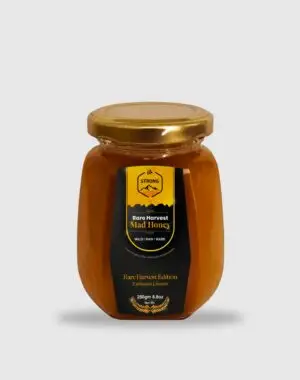
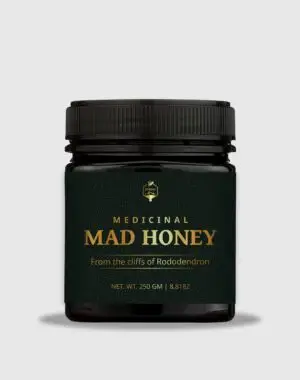
Rare Harvest Mad Honey (Limited)
Rated 5.00 out of 5$ 299.00Original price was: $ 299.00.$ 199.00Current price is: $ 199.00. Add to cart - All Product
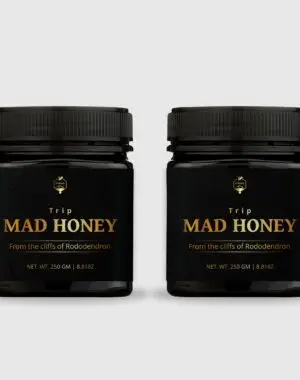
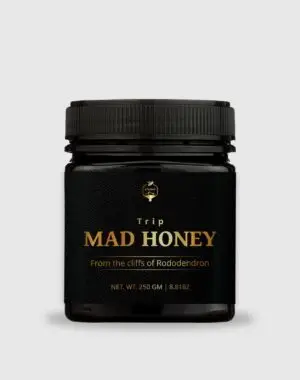
Trip Mad Honey 250g (Strong )
$ 160.00Original price was: $ 160.00.$ 130.00Current price is: $ 130.00. Add to cart
MEDICINAL GRADE
Naturally rich in grayanotoxin for therapeutic use
WILD-HARVESTED
Sourced from Himalayan cliffs by native Gurung beekeepers
LAB-TESTED PURITY
Tested for safety, potency, and quality assurance
SMALL-BATCH CRAFTED
Artisanal production with zero industrial processing
RAW & UNFILTERED
Unprocessed, unheated, and free from additives
GLOBAL SHIPPING
Fast and secure worldwide delivery available
What is Mad Honey ?
Mad honey (deli bal, “crazy honey,” in Turkish) is a rare honey produced when bees forage on rhododendron species — mainly Rhododendron ponticum and R. luteum in Turkey, and high-altitude rhododendrons in Nepal. These flowers naturally contain grayanotoxins, and trace amounts carry over into the finished honey unchanged.

Honey Origin
“Explore the Himalayan roots and natural environment where authentic Mad Honey is harvested.”


Grayanotoxin Profile
“Comprehensive breakdown of the potent grayanotoxins found uniquely in Mad Honey.”


Psycho Effects
“Insight into the mind-altering and physical effects experienced after consuming Mad Honey.”


Safe Dose
“Recommended safe consumption limits to enjoy Mad Honey without adverse side effects.”
Mad honey — deli bal in Turkish, meaning “crazy honey” — gets its name honestly. It’s produced when bees forage on rhododendron flowers, primarily Rhododendron ponticum and Rhododendron luteum in Turkey, and several high-altitude rhododendron species in Nepal. These flowers contain grayanotoxins, a family of compounds the plant produces to deter grazing animals. Bees aren’t affected by the toxin, so they collect the nectar and process it into honey exactly as they would any other nectar source. The grayanotoxin simply rides along, intact, into the finished product.
That single biological fact explains nearly everything distinctive about mad honey: its deep reddish-brown color, its bitter aftertaste, the tingling some people feel on their lips, and the fact that it’s the only commercially sold honey capable of measurably affecting your heart rate. It isn’t infused, treated, or manufactured to be this way — it’s raw honey, unprocessed, exactly as the bees made it. That natural, unpredictable origin is also why authenticity and sourcing matter so much, a point we’ll come back to.
Lab-Tested for Purity & Potency

100% Jar Traceability
No Additives or Preservatives

Wild-Harvested from Himalayan Cliffs
History of Mad Honey
The oldest surviving account comes from the Greek general Xenophon, who described his soldiers eating wild honeycombs near the Black Sea coast in 401 BCE. According to his account, the men collapsed as if drunk, vomiting and disoriented — and recovered fully within a day, unable to recall much of it.
The most cited episode happened centuries later, during the First Mithridatic War in 65 BCE. The historian Strabo recorded that soldiers loyal to King Mithridates VI left honeycombs along a path they knew Pompey’s Roman troops would cross. The Romans ate it, became violently ill, and were ambushed while incapacitated — one of the earliest documented uses of a natural toxin as a weapon of war.
Away from the battlefield, mad honey settled into something far more ordinary: a carefully dosed folk remedy. Communities along Turkey’s Black Sea coast and in Nepal’s high-altitude villages used small amounts for blood pressure, digestion, and general vitality, refined through generations of trial and observation rather than laboratory science. It stayed a regional secret until the 1980s, when isolated case reports of poisoning among foreign tourists began showing up in medical journals. The internet did the rest — by the 2010s, mad honey had gone from a Black Sea curiosity to a product searched for and shipped to customers in the US, UK, and beyond.
Where Mad Honey Comes From
Despite a market that increasingly claims otherwise, authentic mad honey reliably comes from exactly two places.
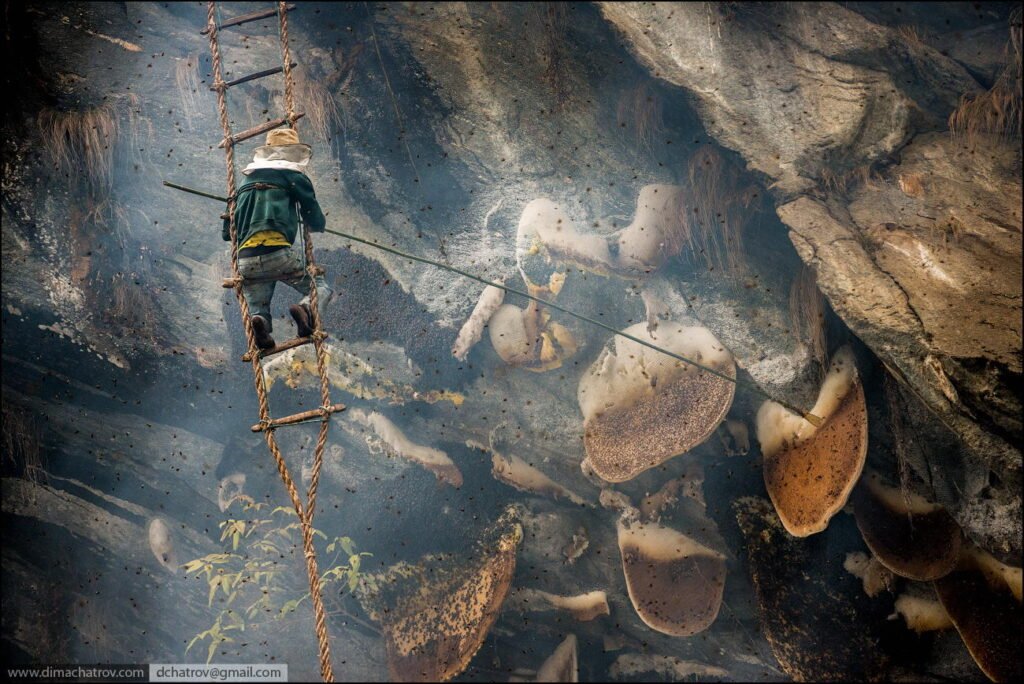
Nepal produces what most people consider the strongest version, harvested above 8,000 feet in the Kaski and Lamjung districts by Apis dorsata laboriosa — the largest honeybee species on Earth, which builds its combs directly on exposed cliff rock rather than in hives. Twice a year, Gurung honey hunters climb to reach them using rope and bamboo ladders built by hand, a practice that hasn’t meaningfully changed in over a thousand years.
Turkey’s version comes from the Kaçkar Mountains near Rize and Trabzon, produced by ordinary managed honeybee colonies foraging at lower altitudes. It has a longer commercial history and is woven more casually into everyday Black Sea cuisine, but tends to be milder and more consistent than Himalayan harvests.
If a product claims to be mad honey without naming one of these two regions, that’s worth treating as a red flag rather than a marketing detail.
How Mad Honey Is Made
Bees collect nectar and carry it back in a specialized stomach, pass it to other bees who break the sugars down with enzymes, fan it with their wings to evaporate excess water, and finally seal each finished cell with wax.
Mad honey follows that exact sequence. The only difference happens before any of it starts — at the moment a bee chooses to forage on a rhododendron flower instead of something else. The toxin in that nectar isn’t broken down, filtered, or altered at any later stage; it simply travels through the process unchanged because bees have no reason, biologically, to treat it any differently than ordinary nectar. This is also why mad honey can’t be replicated artificially in a factory — it’s defined entirely by what the bees happened to forage on, not by anything added afterward.
The Science Behind the Effects
The compound responsible for all of this is grayanotoxin, a diterpenoid that rhododendrons produce as a chemical defense against being eaten. In the human body, it binds to voltage-gated sodium channels in nerve and muscle cells — including the cells of the heart — and holds them open longer than they’re supposed to stay open.
In the heart specifically, this slows the sinoatrial node, the small cluster of cells that sets your natural heart rhythm, and can interfere with the signal that travels between the heart’s upper and lower chambers. That’s the source of the slowed heart rate and dropped blood pressure associated with overconsumption. In the nervous system more broadly, the same mechanism produces the warmth, tingling, and altered sensory perception people describe at lower doses.
It’s worth noting how different this is from other substances people sometimes compare it to. Grayanotoxin doesn’t touch serotonin receptors the way psilocybin does, and it doesn’t trigger dopamine release the way stimulants do. It works through ion channels, full stop — which is part of why the experience it produces doesn’t really resemble a classic psychedelic or a stimulant high, despite sometimes being described in similar language online.
Benefits, Effects & Traditional Use
Mad honey’s risk is entirely dose-dependent, not constant. At low, correctly-measured amounts it’s been used safely for generations; the danger only appears when that dosage discipline breaks down. The full breakdown of safe starting amounts, maximum daily limits, and who should avoid it entirely is covered in our dosage and safety guide.
At low, controlled doses — typically a fraction of a teaspoon — people commonly report a warm, spreading sensation that starts within 15 to 40 minutes, followed by relaxation and a calm, grounded mood that some describe as gentle euphoria. Traditional use across both regions has long centered on supporting healthy circulation and blood pressure, easing minor digestive complaints, and — particularly in Turkish folk medicine — supporting libido and general vitality. Some users also describe a noticeable mental clarity at very small amounts, well below the dose where dizziness would start to appear.
Push the dose higher, and the picture changes. Effects that felt pleasant at a quarter teaspoon can tip into dizziness, nausea, and visual disturbances at a full tablespoon. This isn’t a flaw in the product — it’s the same compound producing a stronger version of the identical effect, which is exactly why dosage discipline matters more here than with virtually any other natural product you might buy. We cover specific dosing and risk in detail in our dosage and safety guide.
Is Mad Honey Legal?
Yes, in the overwhelming majority of countries, including the United States, the United Kingdom, the European Union, Canada, and Australia. It’s classified as a food product rather than a controlled substance, so buying and consuming it is generally no different, legally, than buying any other specialty import. That said, customs rules for food imports do shift from time to time, so it’s worth a quick check of your own country’s current guidelines before placing a large order, particularly if you’re ordering internationally for the first time.
In Nepal and Turkey themselves, mad honey is simply part of the legal, established economy — sold in markets, traded by harvesters, and woven into regional cuisine and medicine without any special restriction.
Safety First: Dosage, Side Effects & Who Should Avoid It
The most cited episode happened centuries later, during the First Mithridatic War in 65 BCE. The historian Strabo recorded that soldiers loyal to King Mithridates VI left honeycombs along a path they knew Pompey’s Roman troops would cross. The Romans ate it, became violently ill, and were ambushed while incapacitated — one of the earliest documented uses of a natural toxin as a weapon of war.
Away from the battlefield, mad honey settled into something far more ordinary: a carefully dosed folk remedy. Communities along Turkey’s Black Sea coast and in Nepal’s high-altitude villages used small amounts for blood pressure, digestion, and general vitality, refined through generations of trial and observation rather than laboratory science. It stayed a regional secret until the 1980s, when isolated case reports of poisoning among foreign tourists began showing up in medical journals. The internet did the rest — by the 2010s, mad honey had gone from a Black Sea curiosity to a product searched for and shipped to customers in the US, UK, and beyond.
How to Tell Real Mad Honey From Fake
Rising demand has, predictably, attracted a flood of diluted and mislabeled products. A few characteristics reliably separate the genuine article from the rest. Authentic mad honey is noticeably darker than standard honey — a deep reddish-amber rather than clear gold — and carries a distinct bitterness that follows an initial sweetness, often with a faint numbing sensation on the tongue. It tends to be thicker and slightly more granular than mass-market honey, and a credible seller will be able to tell you exactly which region and harvest season it came from, not just “imported from Asia.”
The warning signs run the opposite direction: a price that seems too good to be true for a wild-harvested, seasonally limited product; a color indistinguishable from ordinary supermarket honey; vague or missing origin information; and bold potency claims with no lab testing to back them up. Genuine, lab-verified mad honey is labor-intensive to produce, and that reality should show up in how transparent — and how priced — a seller actually is.
What Does the Research Actually Say?
Most of what’s known scientifically about mad honey comes from Turkish emergency medicine, where grayanotoxin poisoning shows up reliably during peak harvest season and has been studied for decades as a result. That research has established the sodium-channel mechanism behind the symptoms, confirmed a consistent clinical picture across hundreds of documented cases, and validated atropine as an effective, fast-acting treatment for the cardiac symptoms specifically.
What’s genuinely less settled is everything outside acute poisoning. Some laboratory testing has found that grayanotoxin concentration can vary noticeably between harvest seasons, which would support the idea that spring honey tends to run more potent than honey collected later in the year — but this is based on a relatively small number of studies, not a large consensus, and shouldn’t be treated as a firm rule. Almost nothing has been studied about the long-term effects of repeated, low-dose use, which means most of the wellness claims circulating online remain traditional and anecdotal rather than clinically validated. That’s not a reason to dismiss them outright, but it is a reason to hold them more loosely than the acute-risk data, which is genuinely solid.
Final Thoughts
Mad honey is one of the rare cases where the strange internet reputation and the underlying reality actually line up. It really does have a measurable effect on the body. It really does come from one of the more remarkable harvesting traditions still practiced today. And it really does carry genuine risk if you treat it casually. None of that needs exaggeration to be interesting — the facts alone are unusual enough.
The difference between a good first experience and a bad one almost always comes down to the same three things: buying from someone who can tell you exactly where it came from, starting with far less than you think you need, and paying attention to what your body tells you along the way. Treated with that much respect, mad honey is exactly what generations of Gurung beekeepers and Black Sea healers have always understood it to be — a genuinely remarkable natural substance, worth trying carefully rather than casually.
Frequently Asked Questions
Is mad honey actually dangerous, or is that overstated?
It’s a fair middle ground: dangerous at high doses, generally well tolerated at low ones. The risk is real but dose-dependent, not constant.
How is mad honey different from regular honey, biologically?
Nothing about the bees or the production process differs. The only difference is the flower the bees foraged on — rhododendron nectar carries grayanotoxin into the finished honey, while clover or wildflower nectar doesn’t.
Can you build a tolerance to mad honey?
There’s no solid research on this either way. Given how potency varies batch to batch, it’s safer to treat every new jar as if you were starting from scratch rather than assuming your previous tolerance still applies.
How much is a safe amount for a first try?
A small fraction of a teaspoon — noticeably less than you’d think — with at least 45 minutes of waiting before considering whether to take any more.
Is Nepalese mad honey really stronger than Turkish mad honey?
Generally, yes, on average, mostly because of the altitude and wild rhododendron density in Nepal’s harvest regions. But potency still varies enough within each region that this is a tendency, not a guarantee.


