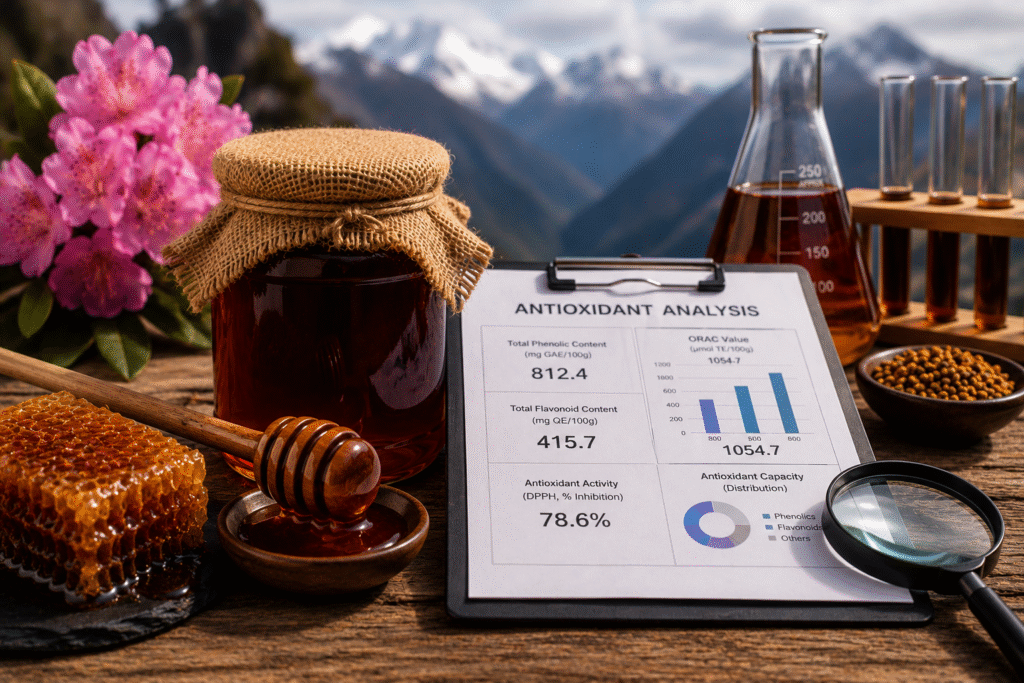
Antioxidants get mentioned often in discussions of raw honey generally, and mad honey sometimes gets swept into that conversation too. But because mad honey’s real claim to fame is its grayanotoxin content rather than its nutritional profile, the antioxidant angle tends to get either ignored or, in some marketing, overstated. This guide gives a realistic accounting of what’s actually known.
The Basic Science of Antioxidants in Honey
Antioxidants neutralize free radicals, unstable molecules linked to cellular damage and, over time, to aging and various chronic conditions. Raw, unprocessed honey of almost any kind contains antioxidant compounds — flavonoids, phenolic acids — largely inherited from whatever nectar and pollen source the bees relied on. This is a property of raw honey broadly, not something unique to mad honey specifically, though the exact mix does shift depending on the plant source involved.
What Rhododendron Origin Contributes
Mad honey’s specific botanical source — rhododendron nectar rather than clover or wildflowers — shapes its particular antioxidant profile. Rhododendron nectar carries its own set of phenolic compounds and flavonoids, alongside the grayanotoxins responsible for mad honey’s better-known effects. A handful of smaller studies on Nepali and Turkish mad honey have found measurable antioxidant activity, generally in the same range as other monofloral raw honeys — though this research base remains considerably thinner than what exists for a product like Manuka.
Where Manuka Sets the Bar
Manuka honey has become the reference point for antioxidant and antibacterial claims in the honey world, backed by a large body of published research and a standardized measurement system (UMF/MGO) quantifying its distinctive compounds, particularly methylglyoxal. Mad honey has nothing comparable — no equivalent depth of research, no standardized rating system for antioxidant strength. That doesn’t mean mad honey lacks antioxidant properties; it means any claim suggesting it rivals or beats Manuka on this specific point isn’t something that can currently be backed up with real data.
How Antioxidant Activity Gets Measured
It’s worth understanding the methodology behind these claims. Researchers typically use lab assays like DPPH or FRAP to measure a sample’s ability to neutralize free radicals in a controlled setting, along with tests quantifying total phenolic and flavonoid content. These give a useful comparative snapshot, but a lab assay result isn’t the same thing as a guaranteed real-world health outcome for someone eating the honey — the two are related but distinct. When studies report mad honey’s antioxidant activity, they’re generally describing these lab results, not a clinically observed benefit in actual people.
Where Mad Honey Sits Among Other Honey Varieties
For context, buckwheat and Manuka honey both tend to score notably high on phenolic and flavonoid measures among commonly studied honeys, largely due to their specific floral sources. Lighter varieties like clover or acacia generally test lower. Based on the limited research available, mad honey lands somewhere in the middle — broadly comparable to other darker, robust-flavored honeys — though this rests on a much smaller body of published work than the more thoroughly studied honey types.
Why This Shouldn’t Be Your Main Reason to Buy It
For most buyers, antioxidant content ends up being a secondary detail, and that’s a reasonable way to see it given the current state of research. If antioxidant intake specifically is a priority, there are far more thoroughly studied, more widely available options — a broad range of fruits and vegetables, and Manuka honey itself — that offer better-documented antioxidant benefits than mad honey can currently claim.
Processing Matters Too
One practical point: antioxidant content in any honey is influenced by processing. Raw, unheated, minimally filtered honey retains more of its natural antioxidant compounds than heavily processed or pasteurized honey, since heat can degrade sensitive compounds. Authentic mad honey is typically sold raw given its traditional harvesting methods, which likely works in its favor here — though again, that’s a property of raw honey generally, not something exclusive to its rhododendron origin.
Reading Antioxidant Claims Skeptically
Given how limited the peer-reviewed research on mad honey’s antioxidant content actually is, treat any marketing presenting specific, confident numbers or comparisons with real skepticism, and focus on what’s genuinely documented rather than what’s asserted on a sales page.
Frequently Asked Questions
Does mad honey have more antioxidants than regular honey?
It contains antioxidant compounds typical of raw honey, shaped by its rhododendron origin, but there isn’t strong research directly comparing it to regular honey in a standardized way.
Is mad honey better than Manuka for antioxidants?
No verified research supports that claim. Manuka has a far larger, more established research base and a standardized rating system that mad honey simply doesn’t have.
Does raw mad honey have more antioxidants than processed versions?
Generally, yes — raw, minimally processed honey retains more natural antioxidant compounds, a property that applies broadly to honey, not just mad honey.
Should antioxidants be my main reason for buying mad honey?
Probably not. Its real distinguishing feature is grayanotoxin content and traditional use, not a research-backed antioxidant profile.
Is there solid research on this specifically?
Some smaller regional studies exist, but the overall body of research is limited compared to more studied varieties like Manuka.


