
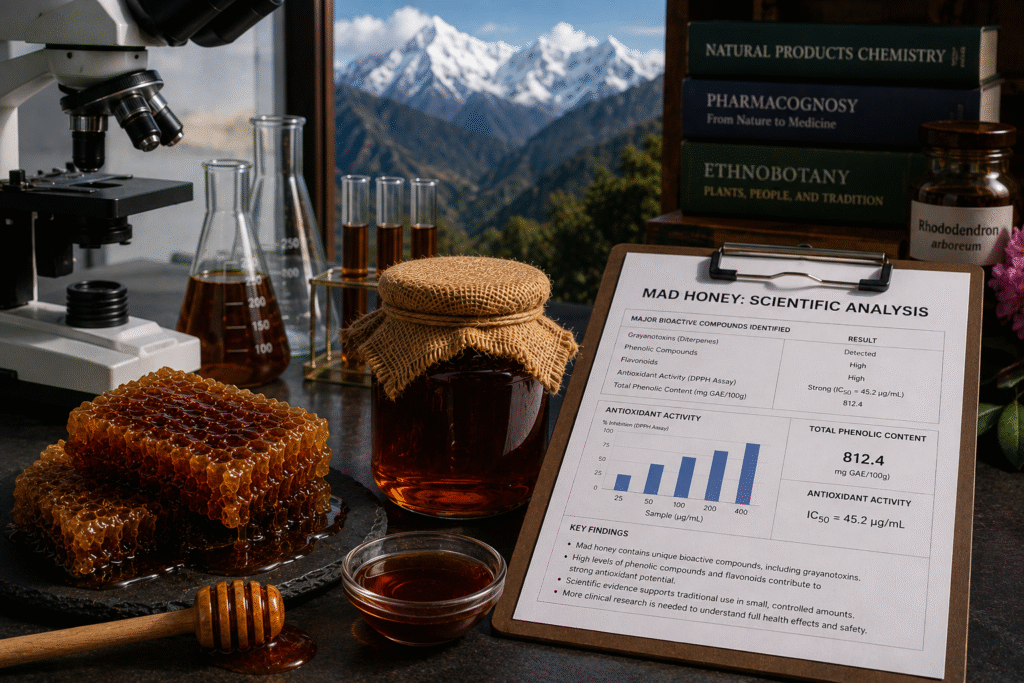
Mad honey has attracted a modest, genuine body of scientific attention over the years, concentrated mostly among Turkish and, to a lesser extent, Nepali researchers. Most of it centers on grayanotoxin poisoning cases rather than the wellness claims most commonly used to market the product. This guide reviews what’s actually been studied, where the evidence holds up, and where popular claims run ahead of the research.
The Bulk of the Research Is About Risk, Not Benefit
The largest and most consistent body of peer-reviewed literature on mad honey consists of clinical case reports from Turkish emergency medicine and cardiology researchers, documenting patients who presented to hospitals after consuming excessive amounts of deli bal, the Black Sea region’s version of mad honey. These reports, published in toxicology and emergency medicine journals, describe symptoms including bradycardia, hypotension, dizziness, and occasionally more serious cardiac complications. It’s the single most robust part of the mad honey research picture, and it centers on documenting harm, not benefit.
The Chemistry Is Reasonably Well Understood
Separate from clinical reports, the chemistry behind grayanotoxins has been studied with reasonable depth. Researchers have identified how these diterpenoid compounds, found in Rhododendron and related Ericaceae species, bind to voltage-gated sodium channels, holding them open longer than normal and disrupting typical electrical signaling in nerve, muscle, and cardiac tissue. This mechanism accounts for both the physical sensations users report and the more serious symptoms documented in poisoning cases — one of the more scientifically solid pieces of the overall picture.
What’s Been Studied on Composition
A smaller set of studies, mostly from Nepali and Turkish researchers, has looked at general antioxidant and phenolic content in mad honey relative to other honey types, along with basic quality metrics like moisture content, pH, and sugar composition. Some studies also use pollen analysis (melissopalynology) to verify geographic origin and authenticity — useful for distinguishing genuine Himalayan or Black Sea mad honey from diluted or mislabeled alternatives, even if it doesn’t speak to wellness claims directly.
The Big Research Gap
Here’s the honest gap: there’s no rigorous clinical research validating mad honey for libido, sexual performance, blood pressure management, sleep, or most of the specific wellness claims found in online marketing. That absence doesn’t necessarily mean these effects are impossible — it means any confident claim about mad honey’s effectiveness for these specific purposes isn’t currently backed by peer-reviewed evidence, and should be treated accordingly. Much of what circulates about mad honey’s supposed benefits comes from tradition, anecdote, and marketing rather than controlled studies.
Case Reports vs Controlled Research
It’s worth understanding the difference here. Case reports document what happened to individual patients after the fact — useful for identifying real risks and symptom patterns, but they don’t involve controlled dosing, placebo comparisons, or the systematic methodology needed to establish a therapeutic benefit. That’s why the poisoning-related research is considered fairly solid — it documents observed outcomes — while benefit-related claims remain largely unstudied by comparison.
Why Bigger Studies Haven’t Happened
Mad honey hasn’t attracted the same research investment as other natural compounds, partly because pharmaceutical and academic funding tends to follow compounds with clearer therapeutic potential, and grayanotoxin’s primary documented significance is as a poisoning risk rather than a promising treatment candidate. Its natural potency variability also makes it a difficult subject for the kind of standardized, repeatable research that funding bodies typically prioritize. That’s unlikely to change dramatically in the near term.
How to Evaluate New Claims You Come Across
If you see a claim referencing “new research” on mad honey, check a few things before trusting it: is it published in a peer-reviewed journal, was it conducted in humans or animals, what specific claim does it actually support, and is the methodology described in enough detail to be credible. Marketing content sometimes references studies loosely or out of context — verifying details directly is a reasonable habit rather than trusting a summary on a sales page.
The Honest Summary
Mad honey occupies an interesting research position: well documented as a genuine cardiovascular risk when misused, reasonably understood at the chemical level, and largely unstudied for the specific wellness claims most often used to sell it. Holding onto that distinction — solid ground on the risk side, open question everywhere else — is the most accurate way to engage with mad honey research.
What a Well-Designed Study Would Actually Need to Look Like
It’s worth spelling out what genuine, rigorous research into mad honey’s claimed benefits would actually require, if only to illustrate the gap between that standard and what currently exists. A meaningful study would need standardized, verified grayanotoxin concentrations across all honey used, a control group receiving a placebo, blinding so participants and researchers don’t know who received what, a clearly defined and measurable outcome, and a sample size large enough to detect a real effect rather than noise. Given the natural potency variability between batches discussed throughout this site, even the first requirement — standardized dosing — presents a genuine logistical challenge that most researchers haven’t attempted to solve, which partly explains why this kind of study doesn’t currently exist for most of the claims associated with mad honey.
How Toxicology Research Differs From Benefit Research in Practice
Toxicology research, which makes up most of what’s actually been published on mad honey, works differently from the kind of research needed to establish a benefit. Researchers don’t need to create a controlled exposure — they simply document what already happened to a patient who arrived in an emergency room, then work backward to understand the mechanism and appropriate treatment. This is inherently easier to conduct ethically and practically than a study requiring researchers to deliberately administer a substance to healthy volunteers to look for a specific benefit, which is part of why the risk side of mad honey research is so much further along than the benefit side.
Where Future Research Might Realistically Head
If mad honey research does expand in the coming years, it’s more likely to happen in the areas that already have some foundation — further characterization of its antioxidant and phenolic profile, better authentication methods to combat counterfeit products, and continued documentation of poisoning cases to refine emergency treatment protocols. Large-scale, controlled studies validating specific wellness claims like libido or blood pressure management remain considerably less likely in the near term, given the funding and methodological challenges already discussed.
Reading Mad Honey Research Like a Skeptic Should
The most useful skill for navigating mad honey information isn’t memorizing every study — it’s developing a habit of asking what kind of evidence actually backs a given claim before accepting it. Applied consistently, that habit will serve you well across every topic covered on this site, not just the scientific research angle specifically.
Frequently Asked Questions
Has mad honey been proven to have health benefits?
Not in the way it’s often marketed. Most rigorous research documents poisoning cases and grayanotoxin chemistry, not validated wellness benefits.
Is the blood pressure connection scientifically documented?
Yes, this is one of the better-supported effects, described across multiple clinical case reports, though as a risk rather than a benefit.
Why is there more research on harm than on benefits?
Poisoning cases bring patients into hospitals, generating clinical data researchers can study and publish. Benefit claims would require controlled studies that haven’t been conducted for mad honey specifically.
Where does most of this research come from?
Primarily Turkish medical researchers studying deli bal poisoning cases, along with smaller Nepali studies on composition.
Should I trust websites citing “studies” for mad honey benefits?
Be cautious — verify the specific study actually supports the specific claim, since many marketing pages reference general honey research or tradition rather than mad honey-specific clinical evidence.


