

By Strong Mad Honey
Honey is made when worker bees collect flower nectar, break it down with enzymes, deposit it into honeycombs, and evaporate its water content by fanning it — turning it into the thick, golden liquid we know as honey. But not all honey is created equal. The how behind the honey matters enormously — and nowhere is that truer than in the cliffs of the Himalayas.
What Is Honey, Really?
Honey is one of nature’s most remarkable substances — a dense, naturally preserved food created entirely by bees from flower nectar. It has been used by humans for over 8,000 years, making it one of the oldest known foods in history.
At its core, honey is a concentrated sugar solution. But it is far more complex than that. It contains over 200 distinct compounds — including fructose, glucose, water, vitamins, minerals, enzymes, amino acids, antioxidants, and in certain rare varieties, powerful bioactive compounds like grayanotoxins found in Himalayan Mad Honey.
The exact composition, flavor, color, and potency of any honey depends almost entirely on one thing: how the honey is made, and more specifically, which flowers the bees visit.
This guide breaks down the complete honey making process — from the moment a forager bee leaves the hive to the moment honey is sealed and ready for harvest.
How Do Bees Make Honey? The Roles Inside the Hive
Understanding how bees make honey starts with understanding the colony structure. A single bee colony can house 20,000 to 80,000 individual bees, each with a highly specific role in the process of honey production.
The Queen Bee — The reproductive center of the colony. She lays up to 2,000 eggs per day and does not participate in honey production directly.
Worker Bees (Female) — These are the true architects of honey. They handle every stage of the honey making process, from foraging to capping. There are two primary types at work:
- Forager Bees — Mature worker bees (typically 3+ weeks old) that leave the hive to collect nectar from flowers, sometimes traveling up to 5 kilometers per trip.
- House Bees (Receiver Bees) — Younger worker bees that remain inside the hive, receive the nectar from foragers, and process it into honey.
Drone Bees (Male) — Their only role is mating with the queen. They play no part in honey production and are typically expelled from the hive before winter.
This division of labor is what makes honey production so remarkably efficient. A single forager bee will produce less than 1/12th of a teaspoon of honey in its entire lifetime — yet collectively, a healthy hive can produce over 100 pounds of honey in a single season.
The Honey Making Process: Step by Step
Here is the complete, scientific process of how the honey is made — from flower field to sealed honeycomb.
Step 1: Foraging — The Search for Nectar
The honey making process begins when forager bees leave the hive in search of flowering plants. Bees are attracted to flowers by color, shape, scent, and the reward of nectar — a sweet liquid secreted by flowers to attract pollinators.
Forager bees locate nectar-rich flowers and communicate their location back to the hive through a behavior called the waggle dance — one of the most sophisticated communication systems in the animal kingdom. Through this dance, a scout bee can communicate the exact direction, distance, and quality of a food source to thousands of her nestmates.
The bee lands on a flower and extends her proboscis (tongue) into the flower’s nectary to draw out the nectar. She stores this in her honey stomach — a dedicated organ completely separate from her digestive stomach — which can hold up to 80mg of nectar.
During this process, the bee also picks up pollen on her body, which she will carry to other flowers, enabling cross-pollination — one of nature’s most vital ecological services.
Step 2: Nectar Collection & Enzyme Activation
Here is where the chemistry of honey begins. As the forager bee draws nectar into her honey stomach, the nectar begins mixing with salivary enzymes — most importantly, an enzyme called invertase (also known as sucrase).
Invertase begins breaking down the complex sucrose molecules in the nectar into simpler sugars: fructose and glucose. This enzymatic process is the first transformation of nectar on its way to becoming honey.
The bee may visit between 50 and 100 flowers per trip before her honey stomach is full. During a busy foraging season, she may make up to 10 trips per day.
Step 3: Passing the Nectar Inside the Hive
When the forager bee returns to the hive, she passes the nectar to a waiting house bee through a process called trophallaxis — essentially mouth-to-mouth transfer. The house bee draws the nectar into her own honey stomach, where the enzymatic conversion continues.
This transfer process may happen multiple times — passed from bee to bee within the hive — each time mixing the nectar further with enzymes, reducing its water content slightly, and allowing further chemical transformation. This chain of transfers can involve up to 50 different bees before the nectar reaches its final storage location.
This is not simply mechanical transfer. Each bee is actively adding enzymatic intelligence to the nectar — a key reason why honey’s complexity cannot be replicated by any industrial process.
Step 4: Depositing Into the Honeycomb
Once the house bees have processed the nectar sufficiently, they deposit it into the hexagonal wax cells of the honeycomb — one of the most geometrically perfect structures in the natural world. Bees build honeycomb from wax secreted by glands on their abdomens, and the hexagonal design allows maximum storage capacity with minimum material.
At this stage, the deposited liquid still has a water content of around 70–80% — far too high to be called honey. True honey has a water content of 17–20% or less. Achieving this requires the next critical step.
Step 5: Evaporation — Fanning the Moisture Out
This is arguably the most critical and time-consuming stage in the honey making process. The bees now begin fanning the nectar-filled cells with their wings at an extraordinary rate — creating a strong airflow across the hive that rapidly evaporates the water content from the nectar.
Thousands of bees work in coordinated shifts to maintain this fanning, sometimes for several days. The warm internal temperature of the hive (typically maintained at around 35°C / 95°F) accelerates the evaporation process.
Simultaneously, the enzyme glucose oxidase in the honey converts some of the glucose into gluconic acid and hydrogen peroxide — giving honey its characteristic mild acidity (pH 3.2–4.5) and natural antimicrobial properties. This is why raw honey has an almost indefinite shelf life.
As the water content drops toward 20%, the nectar becomes increasingly thick, sticky, and concentrated — transitioning into what we recognize as honey.
Step 6: Sealing the Honeycomb with Beeswax
When the moisture content has dropped to around 17–18%, the bees cap each full cell with a thin layer of fresh beeswax, sealing the honey inside. This capping signals to beekeepers that the honey is fully ripened and ready for harvest.
The sealed honeycomb is remarkable for its stability. Sealed honey does not ferment, does not spoil, and retains its nutritional profile indefinitely under the right storage conditions. Archaeologists have discovered sealed honey in ancient Egyptian tombs estimated to be over 3,000 years old — and still edible.
Step 7: Harvest and Processing
Commercial honey extraction typically involves:
- Uncapping the beeswax seals with a heated knife or mechanical uncapper
- Spinning the frames in a centrifuge extractor to force the honey out
- Filtering and heating (in mass production) — which removes pollen, wax particles, and other natural compounds
- Pasteurization (in commercial honey) — heating to kill yeast and extend shelf life
Here is where the quality divide becomes critical. Raw honey is simply strained and bottled — retaining all its enzymes, pollen, antioxidants, and bioactive compounds. Commercially processed honey is typically heated, ultra-filtered, and sometimes adulterated — stripping out much of what makes real honey valuable.
How Is Honey Produced Differently Across the World?
While the biological process of how honey is produced remains the same wherever bees exist, the inputs — the floral sources, altitude, bee species, and harvesting methods — vary enormously. This is why honey from different regions tastes, looks, and functions so differently.
Manuka Honey (New Zealand) — Bees collect nectar from the Manuka tree. Known for high methylglyoxal (MGO) content and antibacterial properties.
Sidr Honey (Yemen/Saudi Arabia) — From the Sidr (Lote) tree. Prized in traditional Islamic medicine, exceptionally rare and expensive.
Tupelo Honey (USA) — From white Ogeechee tupelo trees in Florida. Notably slow to crystallize due to its high fructose ratio.
Buckwheat Honey — Dark, strongly flavored honey with exceptionally high antioxidant content.
Himalayan Mad Honey (Nepal) — The rarest and most extraordinary honey on earth. Collected by the world’s largest bee species from wild Rhododendron flowers at extreme high altitudes — containing naturally occurring grayanotoxins that give it unique psychoactive and medicinal properties.
The Process of Honey Production in the Himalayas
The process of honey production in the Himalayan region of Nepal is unlike anything found elsewhere on earth — and it has remained essentially unchanged for over 1,000 years.
Here, the honey making process begins at altitudes exceeding 8,000 feet (2,400+ meters), where the world’s largest honeybee — Apis dorsata laboriosa — builds its massive open-air nests on sheer cliff faces inaccessible to most predators.
Twice each year — during the spring and autumn harvest seasons — these giant bees collect nectar from wild Rhododendron flowers that blanket the remote Himalayan ridgelines. These flowers contain naturally occurring grayanotoxins — bioactive compounds that transfer through the nectar into the finished honey, giving Himalayan Mad Honey its legendary potency.
The harvest itself is conducted by the Gurung honey hunters — an indigenous tribe of Nepal whose ancestral cliff-harvesting traditions have been passed down through generations for over a millennium. Using handmade rope ladders, bamboo poles, and smoke to calm the bees, these remarkable men descend sheer cliffs to collect honeycombs by hand — a feat of extraordinary skill and courage.
No machinery. No industrial processing. No additives.
Every jar of authentic Himalayan Mad Honey reflects this ancient, uninterrupted process of honey production — from the nectar of wild Rhododendron flowers, through the biology of the world’s largest bee, to the hands of the Gurung hunters, to your door.
What Makes Himalayan Mad Honey So Different?
Now that you understand how the honey is made, you can appreciate why Himalayan Mad Honey stands in a category entirely of its own.
1. The Bee Species Apis dorsata laboriosa — the giant Himalayan cliff bee — is the largest honeybee on earth. Its size allows it to forage at extreme altitudes where no other bee species can survive.
2. The Floral Source Wild Rhododendron flowers (Rhododendron arboreum and related species) are the key. These flowers contain grayanotoxins — naturally occurring neurotoxic compounds that, at controlled doses, interact with the human nervous system to produce deep relaxation, mild euphoria, and enhanced well-being.
3. The Altitude At 8,000+ feet, the air is cleaner, the flora is wilder, and the ecosystem is entirely free from agricultural chemicals, pesticides, or pollution. This purity is directly reflected in the quality of the finished honey.
4. The Harvesting Method Traditional cliff harvesting by Gurung hunters means the honey is never touched by industrial equipment. It arrives raw, thick, dark reddish in color, and exactly as nature produced it.
5. The Compound Profile Unlike regular honey, authentic Himalayan Mad Honey contains measurable levels of grayanotoxins — lab-tested and certified in every batch from Strong Mad Honey — delivering an experience no ordinary honey can offer.
Raw vs. Processed Honey: Why It Matters
Understanding the process of honey production helps explain why raw honey is so vastly superior to the processed alternatives lining supermarket shelves.
| Raw Honey | Processed / Commercial Honey | |
|---|---|---|
| Enzymes | Fully intact | Destroyed by heat |
| Pollen | Present | Removed by ultra-filtration |
| Antioxidants | High | Significantly reduced |
| Antimicrobial Properties | Active | Reduced or eliminated |
| Bioactive Compounds | Preserved | Stripped out |
| Shelf Life | Indefinite (sealed) | Extended artificially |
| Authenticity | Traceable to source | Often blended/adulterated |
When you choose raw, wild-harvested honey from a traceable source — like the authentic Himalayan Mad Honey from Strong Mad Honey — you are getting the full, uncompromised result of millions of years of biological engineering. When you choose a mass-market jar from a supermarket shelf, you are often getting a heated, filtered, blended product that has been stripped of most of what makes honey genuinely remarkable.
Frequently Asked Questions
Q: How long does the honey making process take from nectar to sealed honey?
The complete honey making process — from nectar collection to sealed honeycomb — typically takes between 1 to 3 weeks, depending on hive size, temperature, humidity, and nectar availability. The evaporation stage (fanning down the water content) is usually the most time-consuming part.
Q: How many flowers does it take to make one jar of honey?
A single pound of honey requires bees to visit approximately 2 million flowers and fly a combined distance of over 55,000 miles. That’s more than twice the circumference of the earth — for just one pound.
Q: How do bees make honey without losing the nectar?
Bees have two separate stomach chambers. The honey stomach (crop) is dedicated entirely to nectar storage and enzymatic conversion, and is physically sealed from the digestive stomach by a valve. Nectar is only passed to the digestive stomach when the bee needs to feed herself.
Q: Why is Himalayan Mad Honey so much more expensive than regular honey?
The extreme altitude, the inaccessible cliff-face harvesting locations, the traditional Gurung harvesting methods, the rarity of the bee species involved, and the limited twice-annual harvest seasons all contribute to its rarity and price. Additionally, every batch is independently lab-tested for grayanotoxin levels and purity.
Q: Is Mad Honey the same honey making process as regular honey?
The biological honey making process is identical — bees collect nectar, convert it with enzymes, deposit it into combs, evaporate the moisture, and seal it with wax. The difference is entirely in the inputs: the altitude, the bee species (Apis dorsata laboriosa), and the floral source (wild Rhododendron flowers) — which together produce a honey containing the unique bioactive compound grayanotoxin, found nowhere else on earth.
Q: How is honey produced commercially vs. traditionally?
Commercial honey production uses managed Apis mellifera colonies in purpose-built hives, often supplemented with sugar syrup, treated with antibiotics, and processed through high-heat pasteurization and ultra-filtration. Traditional Himalayan Mad Honey production uses wild bee colonies, zero intervention, ancestral harvesting methods, and zero processing — resulting in an entirely different product.
Q: Does Strong Mad Honey test for authenticity?
Yes. Every batch of Strong Mad Honey is independently lab-tested for grayanotoxin levels, purity, the absence of added sugars, chemicals, or artificial substances. Full certifications are available on request.
Conclusion
The question of how the honey is made has a deceptively simple answer: bees collect nectar, transform it with enzymes, evaporate its moisture, and seal it in wax. But within that seemingly straightforward process lies an extraordinary biological achievement — one refined over tens of millions of years of evolution.
And when that process unfolds at the top of the world, on sheer Himalayan cliffs, with the world’s largest bee collecting nectar from wild Rhododendron flowers — the result is something genuinely unlike any other honey on earth.
That is Himalayan Mad Honey. That is Strong Mad Honey.
Ready to Experience the World’s Most Extraordinary Honey?
Now that you know exactly how the honey is made — and what makes the Himalayan process so profoundly different — it’s time to taste the difference for yourself.
Strong Mad Honey offers three strengths of authentic, lab-tested, wild-harvested Himalayan Mad Honey — shipped directly from Nepal to your door, anywhere in the world.
First time? Start with our Medicinal Mad Honey — gentle, wellness-focused, and perfect for beginners.
Ready for more? Try our Strong Trip Mad Honey for a deeper, fuller mind-body experience.
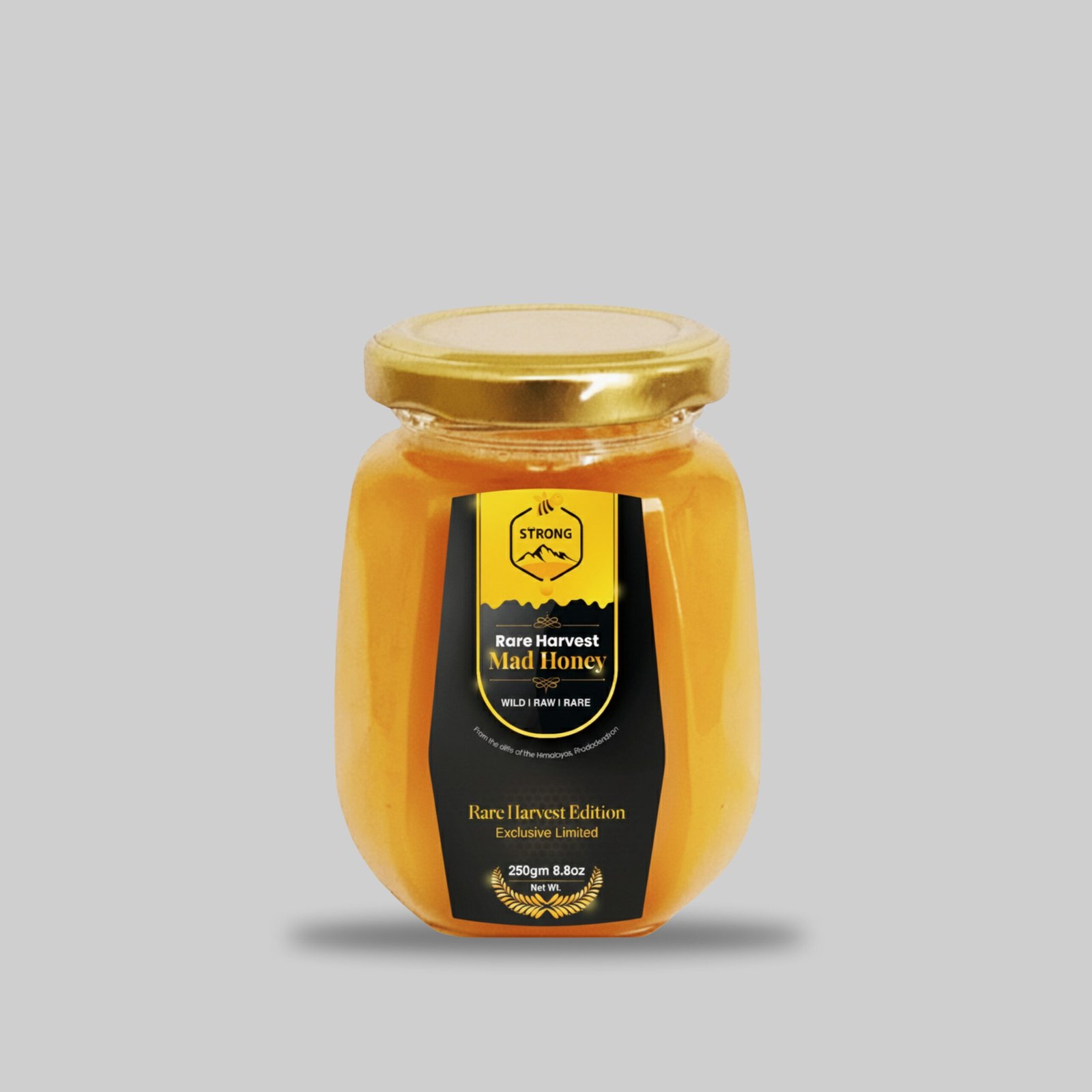
For the experienced only: Our Rare Harvest Mad Honey — limited supply, maximum altitude, maximum potency.
June Sale: Use code MAD10 for 10% off your first order. Free express shipping to the USA.
→ Shop Authentic Himalayan Mad Honey Now
Lab-tested. Wild-harvested. Delivered worldwide. Trusted by 1,200+ customers across 90+ countries.

