
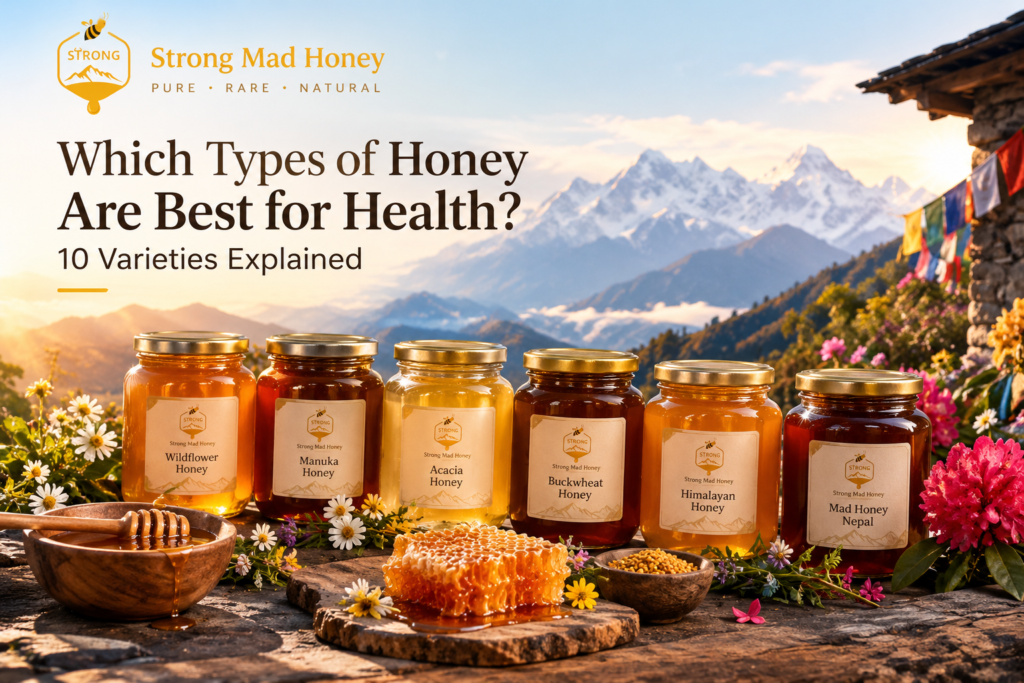
Honey comes in many varieties, each with its own colour, aroma, flavour and floral origin. Some types are mild and delicate, while others have a rich, earthy taste that makes them stand out. Understanding the different types of honey can help you choose the right variety for everyday use, cooking or exploring traditional honey varieties from around the world.
From familiar wildflower honey to premium Manuka honey and rare mad honey Nepal is known for, every variety has a story shaped by its environment and the flowers visited by bees.
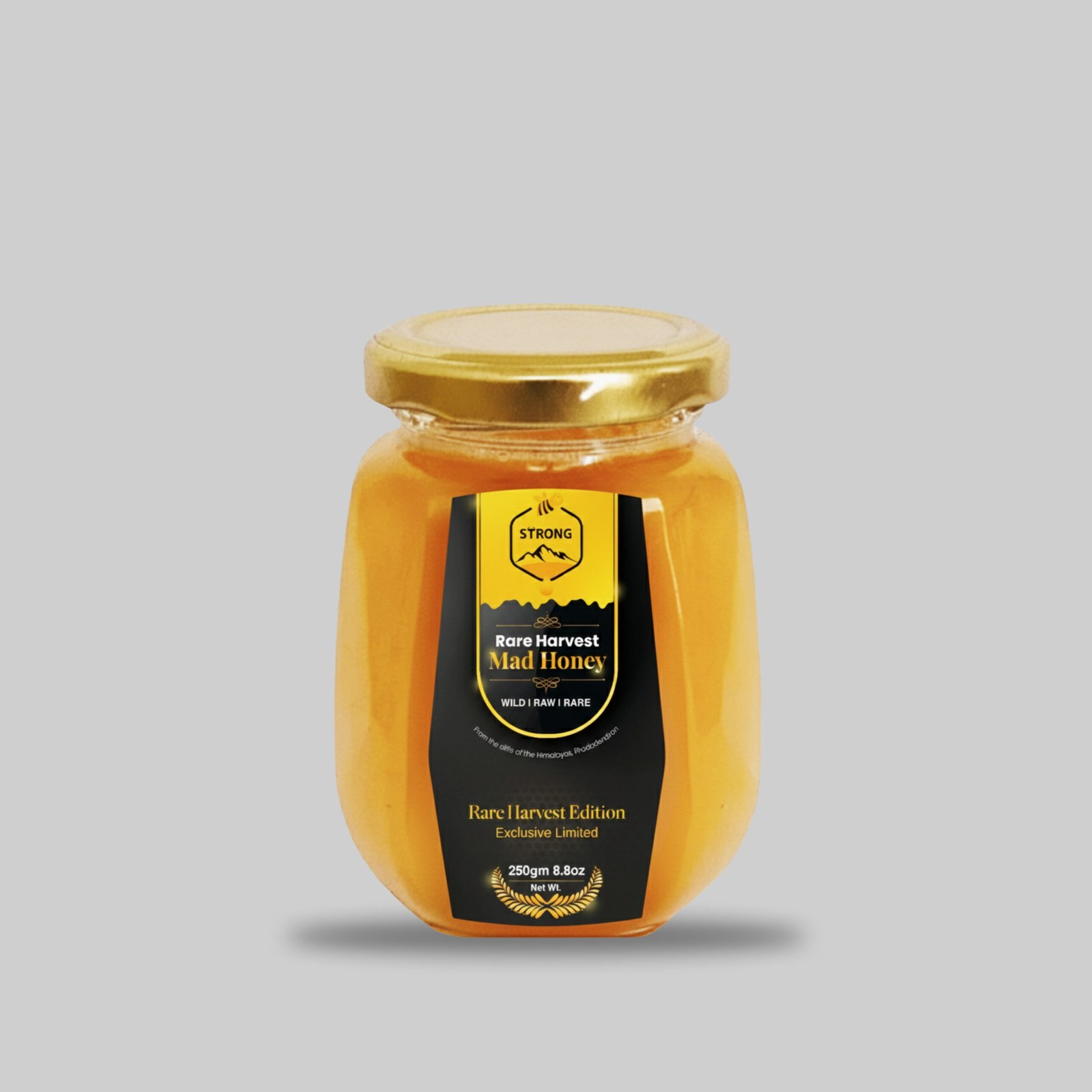
In this guide, we explore popular honey varieties, how they differ, what medicinal mad honey means, and what buyers should know before choosing a specialty honey.
What Are the Different Types of Honey?
Honey is commonly classified by its floral source, processing method, colour and physical form. These categories help explain why two jars of honey can look and taste completely different.
For example, clover honey is usually mild and sweet, while buckwheat honey has a deeper, stronger flavour. Raw honey describes how honey is processed rather than the flowers from which it originates.
Here are some of the most widely recognised honey varieties.
1. Wildflower Honey
Wildflower honey is produced when bees collect nectar from different flowering plants. Its taste, colour and aroma depend on the flowers available during the harvesting season.
Some batches have a light floral flavour, while others taste more robust and earthy. Because the floral sources vary, wildflower honey does not always taste the same from one harvest to another.
Best known for: Everyday use, breakfast, baking and sweetening drinks.
2. Clover Honey
Clover honey is one of the familiar varieties found in supermarkets and households. It generally has a pale golden colour and a clean, mild sweetness.
Its gentle flavour makes it useful in recipes where a strong honey taste is not desirable. It can be drizzled over toast, mixed into yoghurt or used as a sweetener in tea.
Best known for: Everyday sweetening, baking and simple recipes.
3. Acacia Honey
Acacia honey is appreciated for its light colour, delicate floral aroma and relatively mild taste. Depending on its composition, it may remain liquid longer than varieties with higher glucose content. Its subtle flavour works well with fruit, yoghurt, cheese and beverages.
Best known for: A delicate taste and versatile food pairings.
4. Manuka Honey
Manuka honey originates primarily from New Zealand and is produced from the nectar of the Manuka plant. Some varieties are marketed with a UMF rating or an MGO measurement, which relates to specific characteristics used to assess the honey.
Manuka honey is popular in the premium honey market because of its distinctive origin and the scientific interest surrounding its properties. However, the quality of a product should be assessed using reliable testing and transparent labelling rather than marketing claims alone.
Best known for: Premium honey products and its distinctive botanical origin.
5. Buckwheat Honey
Buckwheat honey is typically darker than many everyday varieties. It has a strong, malty flavour with earthy notes that can be particularly noticeable in baking and sauces.
Its bold taste makes it suitable for people who prefer honey with a deeper flavour instead of a delicate sweetness.
Best known for: Baking, marinades and recipes that benefit from a rich honey flavour.
6. Eucalyptus Honey
Eucalyptus honey is produced from the nectar of eucalyptus blossoms. Depending on the species and growing region, it may have an amber colour and a distinctive woody or herbal aroma.
Its flavour can range from moderately sweet to bold, making it an interesting alternative to more common varieties.
Best known for: Exploring distinctive floral flavours and pairing with teas or food.
7. Orange Blossom Honey
Orange blossom honey is associated with flowering citrus trees. It often has a light golden colour and a sweet floral aroma with subtle citrus-like notes.
This variety works well in desserts, salad dressings and drinks where a gentle floral sweetness complements the other ingredients.
Best known for: Desserts, beverages and light-flavoured recipes.
8. Raw Honey
Raw honey describes honey that has undergone minimal processing, although the exact meaning of the term can vary between producers and markets. It is generally not subjected to the same degree of processing as heavily filtered commercial honey.
Raw honey can come from many floral sources, including wildflowers and clover. Its texture may be clear, cloudy or crystallised, depending on its composition and storage conditions.
Best known for: Consumers who prefer minimally processed honey and want information about its source and handling.
9. Himalayan Honey
Himalayan honey refers to honey collected in the Himalayan region. Its characteristics depend on the local flowers, bee species, season and harvesting practices.
Some Himalayan honeys are relatively mild, while others have more pronounced floral or earthy notes. The region is also associated with traditional wild-honey harvesting, including the well-known cliff-harvesting practices found in parts of Nepal.
Not every honey harvested in the Himalayas is mad honey. The botanical source and composition determine the characteristics of the final product.
Best known for: Regional diversity, traditional harvesting practices and distinctive floral origins.
10. Mad Honey from Nepal
Mad honey is a distinctive variety associated with certain rhododendron species. When bees collect nectar containing naturally occurring grayanotoxins, these compounds can be present in the resulting honey.
Nepal is particularly known for its traditional wild-honey harvesting culture in the Himalayan mountains. In some communities, experienced honey hunters use specialised techniques to reach hives located on steep cliffs.
The taste and appearance of mad honey can vary by harvest. Some batches are darker or reddish-amber, with earthy, bitter or floral notes. However, colour and flavour alone cannot confirm authenticity or establish the concentration of grayanotoxins.
People researching mad honey Nepal should look beyond appearance and consider traceable sourcing, accurate product information and appropriate laboratory testing. Because grayanotoxins can cause poisoning, mad honey should not be treated as an ordinary sweetener or assumed to be safe based on its natural origin.
Best known for: Its unusual botanical origin, Himalayan harvesting traditions and distinctive chemical composition.
What Is the Difference Between Regular Honey and Mad Honey?
Although both products are made by honeybees, their floral sources and chemical characteristics can differ significantly.
| Feature | Regular honey | Mad honey |
|---|---|---|
| Floral source | Various flowering plants | Nectar from certain rhododendron species |
| Flavour | Usually sweet; varies by variety | May be bitter, earthy or unusually pungent |
| Appearance | Clear to dark amber | May be amber or reddish-brown |
| Natural compounds | Sugars, enzymes and other minor constituents | May contain grayanotoxins |
| Main consideration | Quality, purity and storage | Authenticity, toxin exposure and food safety |
These differences are not universal for every batch. Visual appearance and taste cannot reliably determine whether a honey contains potentially harmful levels of grayanotoxins.
What Is Medicinal Mad Honey?
The phrase what is medicinal mad honey is commonly used by people researching specialty honey products and their traditional uses.
Medicinal mad honey generally refers to mad honey marketed or discussed in connection with traditional remedies or wellness practices. However, the word “medicinal” does not establish that a product is an approved medicine or that its health claims have been scientifically demonstrated.
Mad honey contains naturally occurring grayanotoxins when sourced from certain rhododendron nectar. These substances can affect the body’s sodium channels and may cause nausea, vomiting, dizziness, low blood pressure, a slow heart rate and potentially serious heart rhythm disturbances.
For this reason, mad honey should not be promoted as a proven treatment for a medical condition. Traditional use and commercial descriptions are not substitutes for reliable clinical evidence.
Consumers should also avoid assuming that a product labelled medicinal is safer, more effective or more carefully tested than other honey. Independent laboratory analysis, transparent sourcing and accurate labelling are important considerations when evaluating specialty honey.
Is Mad Honey Legal in the UK?
The question is mad honey legal in UK is relevant to people researching this specialty product before purchasing or importing it.
Mad honey is not specifically named as a controlled drug under UK drug legislation. However, this does not automatically mean that every product, import or commercial sale is lawful.
Honey sold in the UK is subject to applicable food safety, composition, labelling and advertising requirements. Import rules can also differ depending on the product, its origin, the intended use and whether it is entering the country for personal or commercial purposes.
Businesses considering importing or selling mad honey should verify the current requirements with the relevant UK authorities before placing products on the market. Food products must not be marketed with misleading claims or unsupported promises to treat or prevent diseases.
For consumers, the key point is that legal status and product safety are separate questions. A product being available for purchase does not establish that it is free from harmful toxin levels.
How to Choose Quality Honey
Whether you prefer everyday honey or a rare specialty variety, evaluating quality starts with understanding the product and its source.
Consider these practical points before making a purchase:
- Check the origin: Look for clear information about where the honey was produced and harvested.
- Read the label: Review the ingredients, net weight, producer details and any relevant batch information.
- Look for reliable testing: Where appropriate, independent laboratory reports can help verify composition and identify potential contaminants.
- Understand the variety: Raw, wildflower, Manuka, Himalayan and mad honey describe different characteristics and should not be treated as interchangeable categories.
- Be cautious with health claims: Statements promising guaranteed medical benefits or dramatic effects should be questioned.
- Choose transparent sellers: Reliable product information is more useful than exaggerated descriptions or unsupported claims about purity.
For mad honey in particular, do not rely on colour, taste or traditional harvesting stories as proof of safety.
Final Thoughts
The different types of honey offer a wide range of flavours, origins and characteristics. From mild clover and fragrant orange blossom to robust buckwheat and specialty Himalayan honey, each variety offers something different for curious consumers.
Mad honey from Nepal stands apart because of its particular botanical origin and the traditional harvesting culture associated with it. Nevertheless, its naturally occurring grayanotoxins make careful evaluation especially important.
At Strong Mad Honey, learning about honey varieties, their origins and their differences can help buyers make more informed decisions. Understanding what a product is, how it is sourced and what its limitations are is an essential part of choosing specialty honey responsibly.
Frequently Asked Questions About Types of Honey
Which type of honey is best?
There is no single best type for everyone. Clover and wildflower honey are versatile choices for everyday use, while Manuka, buckwheat and Himalayan varieties appeal to people interested in distinctive flavours or origins. The right choice depends on taste, intended use and product quality.
Is Himalayan honey the same as mad honey?
No. Himalayan honey describes honey associated with the Himalayan region, whereas mad honey refers to honey that may contain grayanotoxins from certain rhododendron nectar sources. Not all Himalayan honey is mad honey.
Why is mad honey from Nepal unique?
Mad honey from Nepal is associated with particular rhododendron species, Himalayan landscapes and traditional wild-honey harvesting practices. Its composition can vary between harvests, so origin alone does not guarantee a specific potency or level of safety.
What is medicinal mad honey used for?
The term is commonly associated with traditional uses and wellness marketing. However, mad honey is not an established treatment for medical conditions, and its grayanotoxin content can create significant health risks.
Is mad honey legal in the UK?
Mad honey is not specifically listed as a controlled drug, but applicable food safety, import, labelling and advertising rules still matter. Check current official requirements for the specific product and circumstances before importing or selling it.
Does darker honey mean better quality?
No. Honey colour depends on factors such as floral source and composition. A darker colour does not automatically indicate higher quality, greater nutritional value or authenticity.