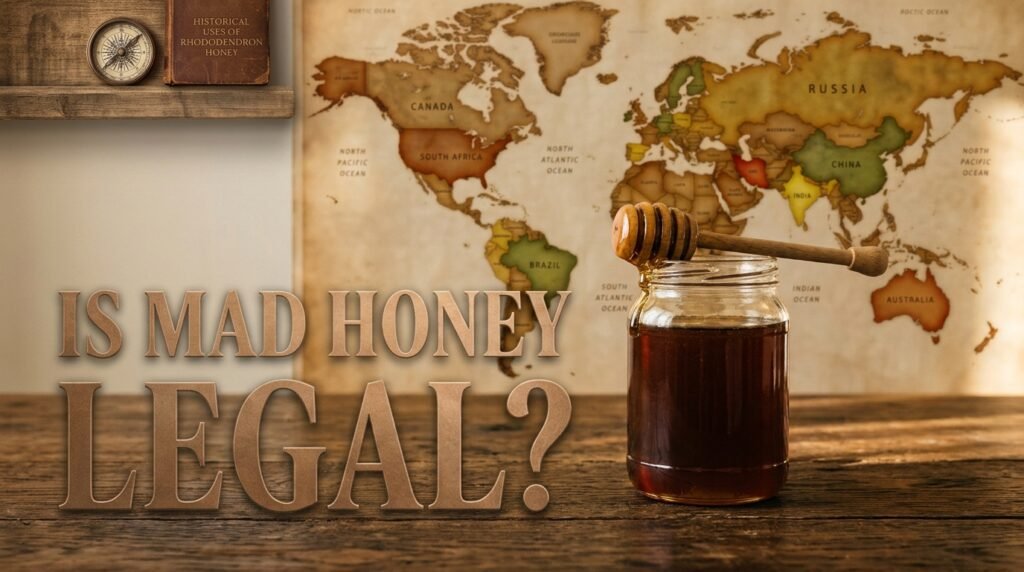
Is mad honey legal? In most major markets, yes, but not everywhere and never without conditions. Mad honey is not a controlled drug in the countries we checked. Governments regulate it as a food, so food safety law, import rules, and biosecurity checks decide what you can buy, sell, or ship. Those rules differ sharply from one border to the next. This guide explains the law in the US, UK, Canada, Australia, New Zealand, Malaysia, India, Europe, and more, using official government sources.
Quick Answer: Where Is Mad Honey Legal?
Mad honey is legal to sell as a regulated food in the United States and the United Kingdom. Canada, Australia, and New Zealand apply strict food safety and import rules that can stop it at the border. South Korea prohibits its import. Most other countries have no law that names mad honey, so general food law applies. Always check your local rules before you buy.
- United States: Legal, regulated as a food
- United Kingdom: Legal, regulated as a food
- Canada: Restricted by food safety law
- Australia: Heavily restricted by biosecurity and food law
- New Zealand: Honey imports tightly restricted
- Malaysia: No specific ban found, general food law applies
- India: No specific ban found, FSSAI food standards apply
- Europe: No specific ban found, but health authorities advise against it
- South Korea: Import prohibited
- Nepal and Turkey: Produced and sold traditionally
This summary reflects our research in October 2026. Laws change, so confirm the current rules with your national food authority.
Why Is the Legal Status of Mad Honey So Complicated?
Mad honey comes from bees that collect nectar from certain rhododendron flowers. These plants produce grayanotoxins, natural toxins that pass into the honey. Governments classify honey as food, not as a drug, so no single global law covers it. Each country applies its own rules on food safety, labeling, and imports. Scientific evidence also keeps growing. The European Food Safety Authority published a risk assessment in 2023 after finding more than 1,000 poisoning cases in the published literature. Regulators now watch this honey closely. For the full background, read our complete guide to mad honey.
Is Mad Honey Legal in the United States?
Yes. US federal law does not list mad honey as a controlled substance, so you can legally buy it in the United States. The FDA treats it as a food. Its natural toxins page names grayanotoxins in honey as a known hazard, and the agency monitors domestic and imported foods for natural toxins. That means the FDA can act against products that are unsafe or mislabeled. If you live in the US, read our guide to buying mad honey in the USA.
Is Mad Honey Legal in Texas and California?
We found no state law in Texas or California that names mad honey. States still regulate food sales, so local rules can differ from federal rules. If you sell or ship mad honey, check with the Texas Department of State Health Services or the California Department of Public Health first.
Is Mad Honey Legal in the UK?
Yes. You can legally buy and sell mad honey in the UK as a food, but it must meet UK food safety law. The Psychoactive Substances Act 2016 exempts food, and it does not cover psychoactive substances that occur naturally in a food. Unsafe food still cannot be sold. The Food Standards Agency’s 2024 honey risk profile lists grayanotoxin as a hazard in imported honey, so sellers must source with care. We found no UK law that bans mad honey by name, including real Himalayan mad honey. Our guide to buying mad honey in the UK explains what to check.
Is Mad Honey Legal in Canada?
Canada has no law that names mad honey, but its food laws are strict. The Food and Drugs Act and the Safe Food for Canadians Regulations require all food sold in Canada to be safe. The Canadian Food Inspection Agency (CFIA) also warns that breaking the rules on importing, distributing, or selling honey can count as a contravention. Honey with harmful levels of grayanotoxin can therefore be refused or removed from sale. Many websites call mad honey flatly illegal in Canada. The reality is more specific: safety and import rules decide each case.
Is Mad Honey Legal in Australia (Aus)?
Australia makes mad honey very hard to bring in. All food sold in Australia must meet the Australia New Zealand Food Standards Code, and honey imports also face biosecurity conditions that protect local bees. The Department of Agriculture publishes those conditions in its BICON system, and Western Australia applies extra rules. Goods that fail import conditions can be exported or destroyed at the importer’s expense. We found no Australian law that names mad honey, but you should treat it as heavily restricted. Check BICON before you order anything.
Is Mad Honey Legal in New Zealand?
New Zealand restricts honey imports even more tightly. The Ministry for Primary Industries lists only Niue, Pitcairn Island, Samoa, Tonga, Tuvalu, and the Solomon Islands as sources of honey that can be imported with a quarantine certificate. Nepal and Turkey do not appear on that list. Imported food must also meet the Food Act 2014 and the Food Standards Code. Contact MPI before you attempt to import any honey.
Is Mad Honey Legal in Malaysia?
Malaysia regulates honey under the Food Act 1983 and the Food Regulations 1985. Regulation 130 sets the standard for honey, and importers must register with the Food Safety Information System of Malaysia (FoSIM). We found no Malaysian law that names mad honey. The Ministry of Health can still act against any food that breaks the Food Act, so confirm the rules with the Food Safety and Quality Division before you import.
Is Mad Honey Legal in India?
As far as we found, India has no law that names mad honey. The Food Safety and Standards Authority of India (FSSAI) sets honey standards under the Food Safety and Standards Act 2006, and those standards apply to both domestic makers and importers. Breaking them can bring fines and imprisonment. Because rules change, ask FSSAI or your state food safety office before you sell or import mad honey.
Is Mad Honey Legal in Europe and Germany?
We found no European law that bans mad honey by name, but regulators warn against it. Germany’s Federal Institute for Risk Assessment (BfR) recommends that people avoid rhododendron honey, especially from the Black Sea region, because it may contain harmful levels of grayanotoxins. EFSA’s 2023 assessment also found that recent poisonings in Europe link mainly to imported honey from Turkey or Nepal. Under EU food law, unsafe food cannot be sold. National rules vary, so check with your country’s food authority.
Is Mad Honey Legal in South Korea?
No. South Korea banned mad honey imports in 2005, and its Ministry of Food and Drug Safety food code says grayanotoxin III must not be detected in honey, according to a peer-reviewed study. Smuggling cases still happen, mostly from travelers who buy the honey in Nepal. If you plan to visit or ship to South Korea, leave mad honey at home.
Is Mad Honey Legal in Nepal and Turkey?
Yes. In Nepal, mad honey is a traditional product of the mountain cliffs, and we found no national ban. In Turkey, people call it deli bal, and it comes from the Black Sea region. Both countries still report poisonings, so local sale does not mean the honey is safe. Exporting or carrying mad honey abroad is a separate matter, because the destination country’s law applies. You can learn more about the honey’s origin on our page about Nepali mad honey.
Is It Legal to Order Mad Honey Online or Carry It Across a Border?
Buying mad honey online is legal where local law allows the product, such as in the US and UK. Crossing a border is where most problems start. Customs and biosecurity officers treat honey as both a food and an animal product, so they can seize it, destroy it, or fine you. Hong Kong’s Centre for Food Safety reports that several poisoning cases involved honey people brought from overseas. Never pack mad honey in your luggage without checking the rules of your destination first.
How to Check the Law Before You Buy Mad Honey
Follow these four steps before you order or travel.
- Search your national food authority’s website for honey import and sale rules.
- Contact your customs or agriculture department and ask about honey and bee products.
- Ask the seller for the origin, harvest region, and testing details of the exact product.
- Keep the receipt and the label with the jar.
Why Regulators Take Mad Honey Seriously
Grayanotoxins affect nerves and muscles. Health agencies describe poisoning that causes vomiting, diarrhea, and dizziness, and in severe cases low blood pressure, a slow heart rate, or shock. The BfR states that science cannot name an exact amount of grayanotoxin honey that triggers poisoning, so no amount is guaranteed safe. A 2012 review in Cardiovascular Toxicology also found little scientific evidence for the medical claims made about mad honey, and warned that such use may even be harmful. Please speak with a doctor before you consider it if you have a heart condition, have low blood pressure, take heart medicine, are pregnant, or are breastfeeding, and keep it away from children. If symptoms start after eating it, call your local emergency number or go to an emergency department. Read our [mad honey precautions guide]([PRECAUTIONS PAGE URL]) for more safety detail.
How to Choose a Transparent Mad Honey Seller
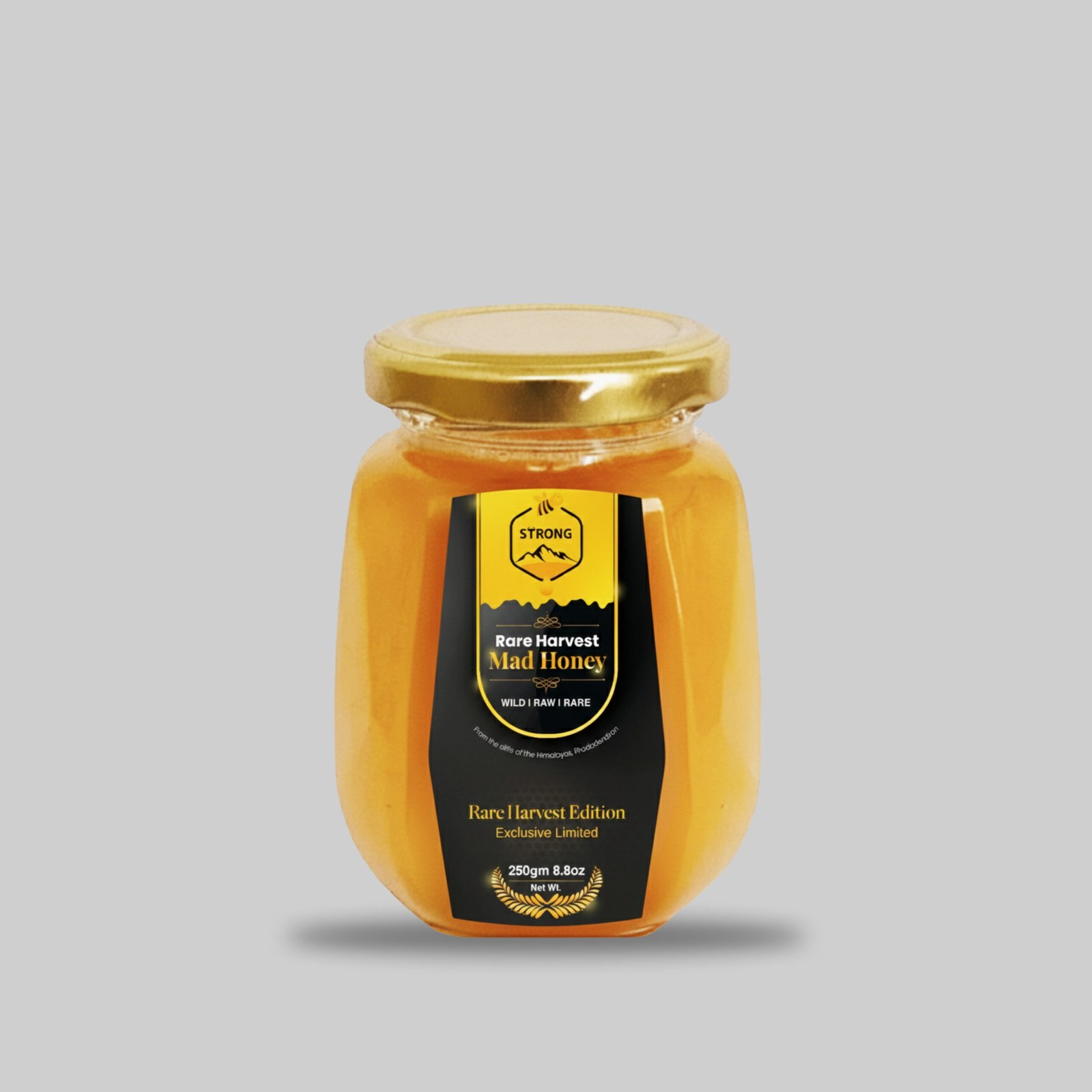
Reliable sellers share where the honey comes from. Strong Mad Honey sources wild harvested honey from the Himalayan region of Nepal, and we label origin clearly on every jar. Look for the same openness from any seller: a named harvest region, clear labeling, and honest safety information. Our guide to original mad honey shows how to spot genuine Himalayan honey. We do not encourage anyone to import mad honey into a country that restricts it.
Mad Honey Legality FAQ
Is mad honey legal in the US?
Yes. US federal law does not list mad honey as a controlled substance, and the FDA treats it as a food. States regulate food sales too, so check local rules, including in Texas and California.
Is mad honey legal in the UK?
Yes. The UK sells mad honey as a regulated food, and the Psychoactive Substances Act 2016 exempts food. Sellers must still meet food safety law, because unsafe food cannot be sold.
Is mad honey legal in Australia?
Australia restricts it heavily. All food must meet the Food Standards Code, and honey imports face strict biosecurity conditions listed in BICON. Check with the Department of Agriculture before you order.
Is mad honey legal in Canada?
No Canadian law names mad honey, but the Food and Drugs Act requires food to be safe. Honey with harmful toxin levels can be refused or removed. Confirm with the CFIA before you buy or import.
Can I travel with mad honey?
Not safely without checking first. Many countries restrict honey imports, and South Korea prohibits mad honey outright. Customs can seize it. Ask the border agency of your destination before you pack it.
Is mad honey a drug?
No. It is classed as a food in the major markets we checked, not as a controlled drug. It still contains grayanotoxins, which can cause poisoning, so regulators treat it as a food safety issue.
Is it legal to buy mad honey online?
It is legal where local law allows the product, such as in the US and UK. If you live elsewhere, check the import rules first, because customs can stop the parcel.
Final Answer: Is Mad Honey Legal?
Mad honey is legal in many countries, including the US and UK, but it is restricted or prohibited in others, including South Korea, and heavily limited in Australia and New Zealand. The law depends on where you live and where the honey crosses a border. Check your local rules, buy only from transparent sellers, and put safety first. Explore our complete guide to mad honey for the full picture, or browse our shop if mad honey is legal where you live.
Sources and References
- U.S. Food and Drug Administration. Natural Toxins in Food. https://www.fda.gov/food/foodborne-illness-contaminants/natural-toxins
- European Food Safety Authority (CONTAM Panel). Risks for human health related to the presence of grayanotoxins in certain honey. EFSA Journal, March 2023. https://pmc.ncbi.nlm.nih.gov/articles/PMC9978999/
- German Federal Institute for Risk Assessment (BfR). Selected questions and answers on grayanotoxins in honey. https://www.bfr.bund.de/en/selected_questions_und_answers_on_grayanotoxins_in_honey-311010.html
- UK Government. Psychoactive Substances Act 2016, Schedule 1: Exempted substances. https://www.legislation.gov.uk/ukpga/2016/2/schedule/1
- UK Food Standards Agency and Food Standards Scotland. Honey Risk Profile, 2024. https://science.food.gov.uk/article/121411-honey-risk-profile
- Government of Canada. Food and Drugs Act. https://laws-lois.justice.gc.ca/eng/acts/f-27/
- Canadian Food Inspection Agency. https://inspection.canada.ca
- Food Standards Australia New Zealand. Australia New Zealand Food Standards Code. https://www.foodstandards.gov.au
- Australian Department of Agriculture. Biosecurity Import Conditions System (BICON). https://bicon.agriculture.gov.au/BiconWeb4.0
- New Zealand Ministry for Primary Industries. Importing honey and bee products. https://www.mpi.govt.nz/import/importing-food-and-beverages/honey-bee-products/steps-to-importing/
- Ministry of Health Malaysia, Food Safety and Quality Division. https://fsq.moh.gov.my
- Food Safety and Standards Authority of India. https://www.fssai.gov.in
- National Library of Medicine (PMC). Review of grayanotoxin and mad honey, including South Korea’s 2005 import ban. https://pmc.ncbi.nlm.nih.gov/articles/PMC9080652
- Hong Kong Centre for Food Safety. Beware of Mad Honey Poisoning, Food Safety Focus, Issue 221, December 2024. https://cfs.gov.hk/english/multimedia/multimedia_pub/multimedia_pub_fsf_221_04.html
- Jansen SA et al. Grayanotoxin Poisoning: Mad Honey Disease and Beyond. Cardiovascular Toxicology, 2012. https://pubmed.ncbi.nlm.nih.gov/22528814/
- Texas Department of State Health Services. https://www.dshs.texas.gov
- California Department of Public Health. https://www.cdph.ca.gov
Disclaimer: This article gives general information only. It is not legal or medical advice. Laws change, so confirm current rules with your national food authority, customs agency, or a qualified lawyer, and speak with a doctor about any health concern.