

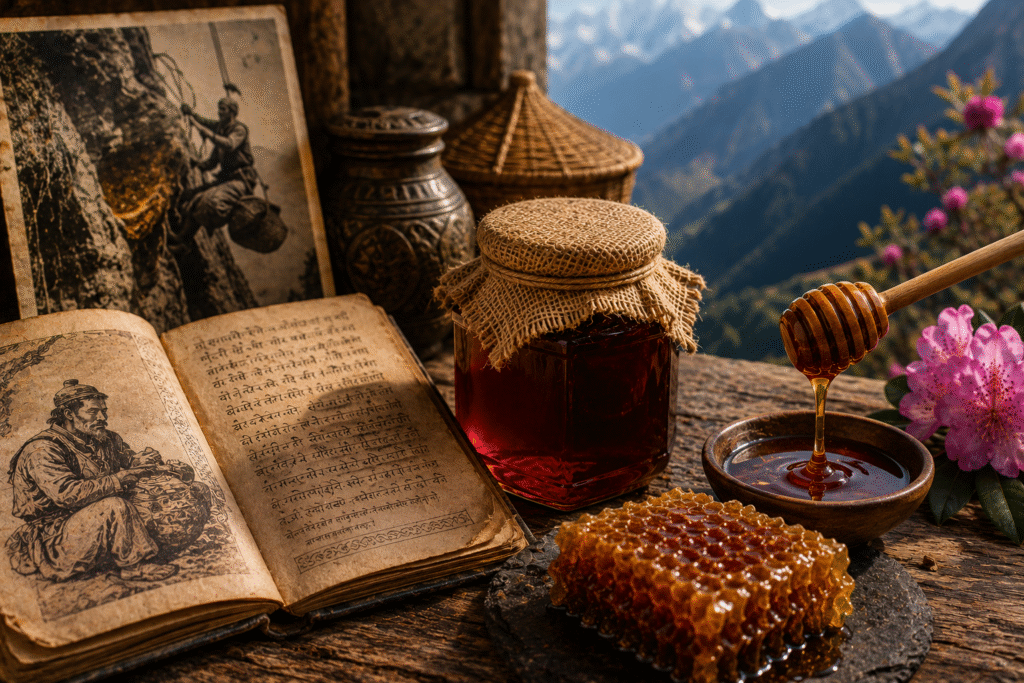
Long before mad honey became an international curiosity, it held a specific, well-understood place in the daily life of Himalayan hill communities, particularly among the Gurung people of central Nepal. Most of what circulates online today compresses that history into a few marketing-friendly bullet points. This guide goes deeper, walking through what’s actually documented about how mad honey has traditionally been used, and how that fuller picture compares to the simplified version most buyers encounter.
The Honey Hunt Itself
Everything about mad honey starts with the hunt. Twice a year, during spring and autumn, honey hunters in Nepal’s mid-hills climb hand-woven rope ladders hundreds of feet up sheer cliff faces to reach the nests of Apis laboriosa, the world’s largest honeybee, which builds exposed combs on rock overhangs specifically to stay out of reach of predators. It’s dangerous, physically punishing work, and it’s typically accompanied by ritual — offerings, songs, and specific protocols meant to appease forest spirits and protect the climbers. This isn’t incidental detail; it’s central to why mad honey carries the cultural weight it does within these communities.
Fueling Physical Labor
The most consistently documented traditional use is as a source of stamina before demanding physical work. Farmers preparing for long days on steep terraced fields, porters hauling loads across mountain trails, and the honey hunters themselves before their climbs have traditionally taken small amounts beforehand. This use reflects the honey’s grayanotoxin content, which produces a distinct physical sensation unlike the simple sugar rush of ordinary honey, and it’s the root of mad honey’s broader modern reputation around energy.
A Role in Local Medicine
Beyond stamina, mad honey has occupied a place in traditional Himalayan medicine, used occasionally for specific complaints — digestive discomfort, seasonal ailments — passed down through generations of local knowledge. It’s important to be clear that these traditional medicinal uses were never standardized or clinically studied to modern standards. They reflect specific cultural and historical context, not an evidence-based treatment protocol, and referencing this history shouldn’t be mistaken for validating any particular medical claim.
The Quieter Evening Ritual
Separate from the stamina-focused daytime use, some communities have traditionally taken a small amount of mad honey in the evening, mixed with warm water, as part of settling down for the night. This reflects the same underlying compound producing a different sensation depending on amount and context, and it stands in real contrast to the more widely discussed daytime use. Mad honey has also occasionally featured in ceremonial or celebratory contexts, tied to the significance of a successful, dangerous harvest.
How It Traveled Through Regional Trade
Mad honey moved through regional trade networks connecting Nepal’s hill communities to neighboring areas well before its recent international recognition, carrying value as both a practical good and a trade item precisely because of its rarity and distinctive effects. This trade history is part of why neighboring regions, including Turkey’s Black Sea coast, developed their own independent traditions around rhododendron-derived honey, without any direct historical link to Nepal.
What’s Being Preserved, and Why
Honey hunting faces real pressure today, from shifting land use to younger generations moving toward other work, which has made preserving this tradition an active concern for both the communities themselves and outside researchers. Some villages have worked to document their practices and pass down the rituals and techniques more formally, partly in response to growing outside interest and partly to keep the practice alive as cultural heritage independent of commercial demand. What reaches international buyers today is tied to a living tradition, not a historical reenactment staged for commercial purposes.
What Gets Lost in International Marketing
When mad honey is sold to buyers outside Nepal and Turkey, this cultural depth tends to get flattened into a handful of simple claims — energy, stamina, sometimes libido. That’s understandable from a sales perspective, but it shortchanges a tradition that actually involves community identity, real physical risk, ritual, and generations of specific, accumulated knowledge about a genuinely demanding harvest.
Applying This History Responsibly Today
The clearest lesson from mad honey’s traditional use is the level of respect and caution with which it was approached by the people who understood it best. Carrying that same mindset forward — occasional use, small amounts, real attention to your own body’s response — fits its actual history far better than treating it as a casual, frequent wellness product.
The Physical Demands of the Honey Hunt Itself
It’s worth dwelling a bit longer on just how demanding the honey hunt actually is, since this context often gets reduced to a single dramatic photo in international coverage. Hunters typically work in small teams, with one or two climbers ascending the rope ladder while others manage smoke to calm the bees and lower baskets to collect the honeycomb. The cliffs involved can exceed two hundred feet, with no safety equipment beyond the ladder itself and the collective experience of the team. Stings are common and expected, not a rare mishap, and the entire operation depends on generations of accumulated, informally taught knowledge about bee behavior, weather conditions, and the specific cliffs being climbed. This level of risk and skill is part of why the resulting honey has never been treated casually within the communities that produce it.
How Knowledge Has Traditionally Been Passed Down
Unlike a written medical or culinary tradition, most of what’s known about mad honey’s traditional uses has been passed down orally, through direct apprenticeship and family knowledge rather than documented texts. Younger community members traditionally learned the honey hunt, along with the associated uses of the honey itself, by working alongside experienced hunters and elders over years, not from a manual or formal curriculum. This method of transmission is part of why some details about traditional use vary somewhat between villages and families — the tradition was never centralized or standardized to begin with, which also makes any single, universal claim about “the traditional use” of mad honey somewhat oversimplified.
Why Outside Researchers Have Struggled to Document This Fully
Anthropologists and ethnobotanists who have studied Nepal’s honey hunting tradition generally note that fully documenting the practice is genuinely difficult, given its oral transmission, the remoteness of the communities involved, and understandable reluctance in some cases to share detailed knowledge with outsiders. This means published academic accounts of mad honey’s traditional uses, while valuable, likely represent an incomplete picture rather than an exhaustive one, and there’s probably more nuance to the tradition than what’s made it into the more accessible sources available to international readers.
A Tradition Worth Understanding on Its Own Terms
Mad honey’s traditional uses deserve to be understood as a genuine part of Himalayan cultural history, not just a backstory attached to a product listing. The more you understand about the honey hunt, the communities behind it, and the specific, occasional way the honey was traditionally used, the more clearly you can separate an authentic product and its real history from a jar riding on borrowed mystique.
Frequently Asked Questions
Who traditionally harvests mad honey?
The Gurung communities of Nepal’s mid-hills, who climb cliff faces to reach wild hives of Apis laboriosa during specific seasonal windows.
Was it traditionally used every day?
No — traditional use was occasional and purpose-driven, tied to specific physical tasks or evening rituals, not routine daily consumption.
Is the traditional medicinal use scientifically validated?
No. It reflects historical and cultural knowledge, not clinical research meeting modern standards.
Does Turkey have a similar tradition?
Yes, independently developed in the Black Sea region around what’s locally called deli bal, based on the same underlying botanical source.
How does this compare to modern mad honey marketing?
Traditional use was specific and community-based; modern marketing often flattens that into a few simplified, broader claims not well supported by the actual history.


