
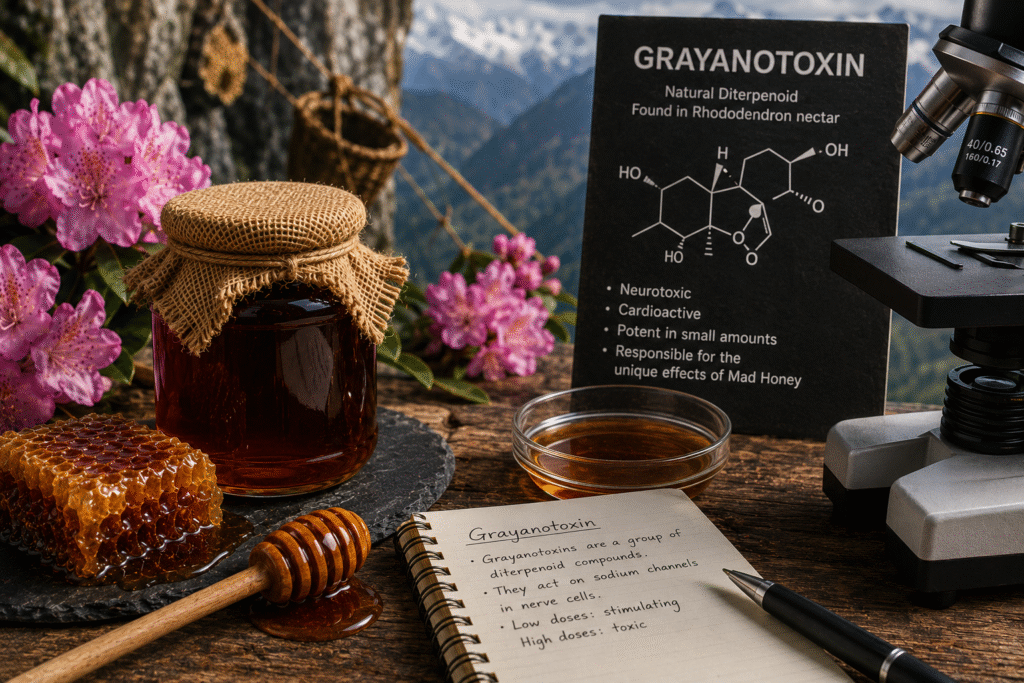
Grayanotoxin is the single compound responsible for everything that sets mad honey apart, and it’s important to start with the fact that it’s classified, chemically and medically, as a toxin. That word should frame everything else in this conversation. This guide explains what grayanotoxin actually is, why it still generates so much search interest despite that label, and why respect and caution matter more than curiosity here.
The Chemistry, Simplified
Grayanotoxins are diterpenoid compounds naturally produced by plants in the Ericaceae family, including the specific high-altitude rhododendron species found in Nepal and parts of Turkey. Bees that forage on these plants carry the compound into the nectar they collect, and it ends up in the resulting honey. Mechanically, grayanotoxins bind to voltage-gated sodium channels in cell membranes and hold them open longer than normal, disrupting the typical electrical signaling that nerve, muscle, and cardiac cells depend on. That’s a toxin in the precise, technical sense — a compound that produces its effect by disrupting normal cellular function, not a nutrient or vitamin doing something beneficial for the body.
Why “Benefits” Still Gets Searched
Despite the toxin classification, grayanotoxin is the entire reason mad honey exists as a distinct product — without it, mad honey would just be ordinary honey. The physical sensations people report after small, controlled exposure — warmth, heaviness, a shift in alertness or calm depending on context — are what drive interest in “benefits.” Worth naming clearly: the interest isn’t really in a nutritional or medicinal benefit in the traditional sense. It’s in a specific bodily sensation from low-level exposure, not unlike how people discuss the effects of other naturally occurring plant compounds without necessarily calling them beneficial in a clinical sense.
What Light Exposure Reportedly Involves
Based on traditional use and anecdotal reports, small amounts of grayanotoxin through mad honey are commonly described as producing warmth, physical heaviness, a shift in alertness — sometimes read as energizing, sometimes as calming depending on amount and setting — and occasionally mild lightheadedness. These are subjective, self-reported experiences, not measured clinical outcomes, and they vary significantly with individual sensitivity, body weight, and the specific potency of a given batch.
What Higher Exposure Actually Does
At higher amounts, the same mechanism responsible for these reported sensations is what causes grayanotoxin poisoning, extensively documented in clinical case reports, mostly from Turkey. Symptoms include a significantly slowed heart rate, low blood pressure, dizziness, excessive sweating, nausea, blurred vision, and in more serious cases, fainting or significant cardiac complications requiring treatment. The line between a mildly pleasant sensation and a genuinely dangerous reaction isn’t fixed — it depends heavily on individual sensitivity and batch potency, which is precisely why this compound should never be treated casually.
Why “Benefits” Isn’t the Right Word
Given all this, “effects” is a more accurate word than “benefits.” Unlike a vitamin or a well-studied compound with an established therapeutic function, grayanotoxin doesn’t have a defined beneficial role in the body — its effects are a byproduct of interfering with normal cellular signaling. Any sensation someone finds pleasant at low exposure exists on the same spectrum as the poisoning symptoms that occur at higher exposure, just at a different point on it — a fundamentally different situation from an antioxidant compound with an actual protective function independent of dose.
Potency Varies More Than Most People Expect
Grayanotoxin concentration shifts depending on the specific rhododendron species, hive altitude, harvest season, and even conditions within an individual hive. That means the same weight of honey from two different batches can contain meaningfully different amounts of the compound — a major reason we don’t publish dosage recommendations anywhere on this site. Every new batch should be treated as an unknown quantity, regardless of prior experience with a different one.
Not All Natural Compounds Are Gentle
Grayanotoxin is a useful reminder that “natural” doesn’t mean “automatically safe.” It’s produced entirely by a plant, occurs in honey through an entirely natural process, and is still capable of causing serious cardiovascular symptoms in excess. Many naturally occurring compounds — certain mushrooms, various plants — carry similar risk profiles. Treating grayanotoxin with the same respect you’d give any other potent natural compound, rather than assuming its origin makes it gentle, is the accurate mindset.
Who Should Avoid Exposure Entirely
Given its documented effects on heart rate and blood pressure, anyone with an existing heart condition, blood pressure issue, or who is pregnant, breastfeeding, or on related medication should avoid mad honey — and therefore grayanotoxin exposure — entirely. It should never be combined with alcohol or anything else affecting the cardiovascular or nervous system. This is general information, not medical advice, and anyone with specific health questions should consult a doctor before considering mad honey at all.
How Grayanotoxin Fits Among Other Plant-Derived Toxins
Grayanotoxin belongs to a broader category of naturally occurring compounds that plants have evolved specifically as a defense mechanism against being eaten by animals, a category that also includes things like solanine in green potato skins or certain alkaloids found in nightshade plants. This evolutionary context is worth understanding: the rhododendron species producing grayanotoxin didn’t evolve this compound for any benefit to humans or bees — it developed as a deterrent against herbivores. Bees appear to have some tolerance for it that allows them to forage on these plants without harm, but that tolerance doesn’t transfer to the humans who later consume the resulting honey, which is exactly why the compound retains its potency once it ends up in a jar on a shelf.
Why the Term “Mad Honey” Exists in the First Place
The name itself comes from historical accounts of the honey’s effects, documented as far back as ancient Greek writings describing Roman soldiers becoming disoriented after consuming rhododendron-derived honey left behind by local tribes as a deliberate ambush tactic. This isn’t a modern marketing name — it reflects a genuinely old recognition, across very different cultures and centuries, that this particular type of honey behaves differently from ordinary honey. That historical continuity is itself a form of evidence, even without modern clinical trials, that grayanotoxin’s effects are real, significant, and have been recognized as such for a very long time.
Respecting the Compound Without Being Afraid of It
None of this is meant to suggest grayanotoxin should be treated as something to fear outright or avoid discussing honestly. Plenty of naturally occurring compounds humans interact with, from capsaicin in chili peppers to caffeine itself, carry real physiological effects and require some baseline understanding to use safely. Grayanotoxin sits at a more potent point on that spectrum than either of those examples, which simply means the margin for error is smaller and the need for caution, accurate information, and quality sourcing is correspondingly greater.
Frequently Asked Questions
Is grayanotoxin actually good for you?
No, not in the way that phrase usually implies. It’s a toxin that disrupts normal cellular signaling. Some people find the sensation from low exposure pleasant, but that’s not a nutritional or medicinal benefit in any clinical sense.
Why do sellers describe it as beneficial?
Marketing sometimes frames the sensation from small exposure as a “benefit,” overlooking that the same compound causes documented poisoning at higher amounts. “Effect with real risk” is more accurate than “benefit.”
How much grayanotoxin is in a typical jar?
This varies significantly by batch, based on rhododendron species, altitude, and harvest season — we don’t publish specific figures because potency is inherently inconsistent.
What separates a pleasant sensation from poisoning?
They exist on the same spectrum, not as separate phenomena. The difference comes down to amount consumed relative to individual sensitivity.
Is regular consumption safe?
Not something we recommend. Traditional use was occasional, not routine, and repeated exposure without understanding your own sensitivity increases risk over time.


