

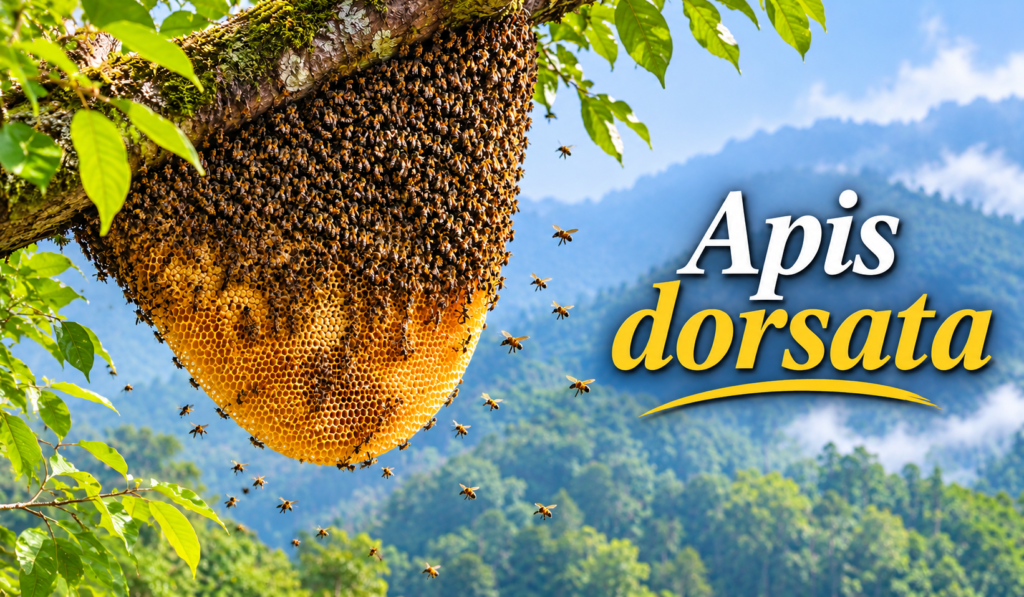
Apis dorsata is the giant honey bee, also called the rock bee. It is a wild honey bee from tropical South and Southeast Asia. Workers are about 17 to 20 millimeters long, which makes them 30 to 50 percent larger than other honey bees. They build one huge open comb under tree branches, cliffs, and buildings, and they defend it fiercely. People cannot keep them in hives, and they are not the Himalayan honey bee that makes Nepal’s mad honey. This guide explains what Apis dorsata is, how big it grows, how dangerous it is, and how it compares with Apis laboriosa.
What Is Apis dorsata?
Apis dorsata is a wild honey bee that lives in the warm parts of South and Southeast Asia. It is one of the largest honey bees in the world, and unlike the western honey bee, it builds its nest in the open air. Here are the key facts about this giant honey bee:
- Common names: giant honey bee and rock bee
- Size: about 17 to 20 mm long
- Color: golden, black, and pale bands on the abdomen, with a hairy thorax
- Range: the Indian subcontinent, southern China, Indonesia, and Malaysia
- Nest: one large open comb hanging under a branch, cliff, or building
- Kept in hives: no
How Big Is Apis dorsata? Honey Bee Size Explained
Australia’s Department of Agriculture describes the giant honey bee as up to 2 cm long. A second Department of Agriculture page says it is 30 to 50 percent larger than other honey bees. Field guides give 17 to 20 mm, and some university sources report workers up to 3 cm, so published sizes differ. In every case, the giant honey bee is much bigger than the western honey bee, so size is a quick way to spot it. Unlike most honey bees, the queens and drones are barely larger than the workers.
The largest honey bee in the world is not Apis dorsata. That title belongs to Apis laboriosa, the Himalayan giant honey bee, which is slightly larger.
Where Does Apis dorsata Live?
Apis dorsata lives across tropical and subtropical Asia, from India and southern China to Indonesia and Malaysia. It does not live in North America, and it is not present in Australia. Scientists still refine its classification. A 2025 research editorial reports that genetic studies split the Apis dorsata group into four geographic lineages, and some of them may deserve species status.
How Does the Rock Bee Build Its Nest?
A colony builds one huge comb in the open, usually under a thick branch or a cliff ledge. Scientists report combs up to about 1.5 meters long. A living curtain of workers, three or four bees thick, covers the comb, and research hosted by the National Institutes of Health reports that 60 to 80 percent of the workers regularly take part in this envelope. In parts of Asia, a single “bee tree” can hold dozens of nests, and these bees also like to nest in buildings and other man-made structures. Many colonies leave their nest and move with the seasons, and they leave an empty comb behind.
Are Apis dorsata Dangerous?
Yes, they can be. Giant honey bees are among the most defensive honey bees, and a disturbed colony can launch a mass attack. Most people never face this, because the bees nest high and ignore people who keep their distance. Noise, smoke, vibration, or climbing near a nest can trigger an attack.
A single sting is painful, but the real danger comes from many stings at once, which can cause serious illness. People with a bee sting allergy face a higher risk. If giant honey bees attack:
- Move away quickly toward a building or vehicle
- Cover your face and head
- Do not swat at the bees
- Call your local emergency number if you have many stings, trouble breathing, swelling of the face or throat, or dizziness
How Does Apis dorsata Defend Its Nest?
The bees use a collective display called shimmering. When a wasp or hornet hovers near the nest, the bees on the surface flip their abdomens upward one after another, and a wave ripples across the comb. A study of colonies in Nepal, hosted by NIH, filmed 450 encounters between giant honey bees and hornets and concluded that shimmering is a key defense for open-nesting bees. The wave confuses predators and warns them off before the bees need to sting.
Can You Keep Apis dorsata in a Hive?
No. Apis dorsata beekeeping does not work the way it does with western honey bees. The bees build open combs, migrate with the seasons, and abandon nest sites, so no hive box can hold them. People instead harvest honey from wild colonies, and in some regions they use traditional rafter systems that give wild colonies a place to nest within reach. Professional honey hunters harvest seasonally, even though the bees defend their nests fiercely. Responsible harvesting leaves part of the comb and the young bees in place, so the colony can survive.
Does Apis dorsata Make Honey?
Yes. Apis dorsata stores honey in its large comb, and honey hunters across India and Southeast Asia harvest it seasonally. Wild honey from forest flowers usually tastes different from standard shop honey, and it varies by season and place. Most of the honey you buy in a store comes from the western honey bee instead. If you are curious about how long these bees live, read our guide on how long a honey bee lives.
Apis dorsata vs Apis laboriosa vs the Western Honey Bee
Scientists once treated Apis laboriosa as a mountain race of Apis dorsata. Today most researchers treat it as a separate species. This comparison shows how the three bees differ:
| Feature | Apis dorsata | Apis laboriosa | Western honey bee (Apis mellifera) |
|---|---|---|---|
| Common name | Giant honey bee, rock bee | Himalayan giant honey bee, cliff bee | European honey bee |
| Size | 17 to 20 mm, 30 to 50% larger than other honey bees | Slightly larger than Apis dorsata | Smaller than both |
| Where it lives | Tropical and subtropical Asia | Mountain regions of the Himalayas, mostly above 1,500 m | Worldwide |
| Nest | One open comb under branches, cliffs, and buildings | One open comb on cliff faces | Several combs inside a cavity |
| Kept in hives | No | No | Yes |
| Known for | Wild forest honey | Himalayan cliff honey | Most shop honey |
The Himalayan Honey Bee and Mad Honey
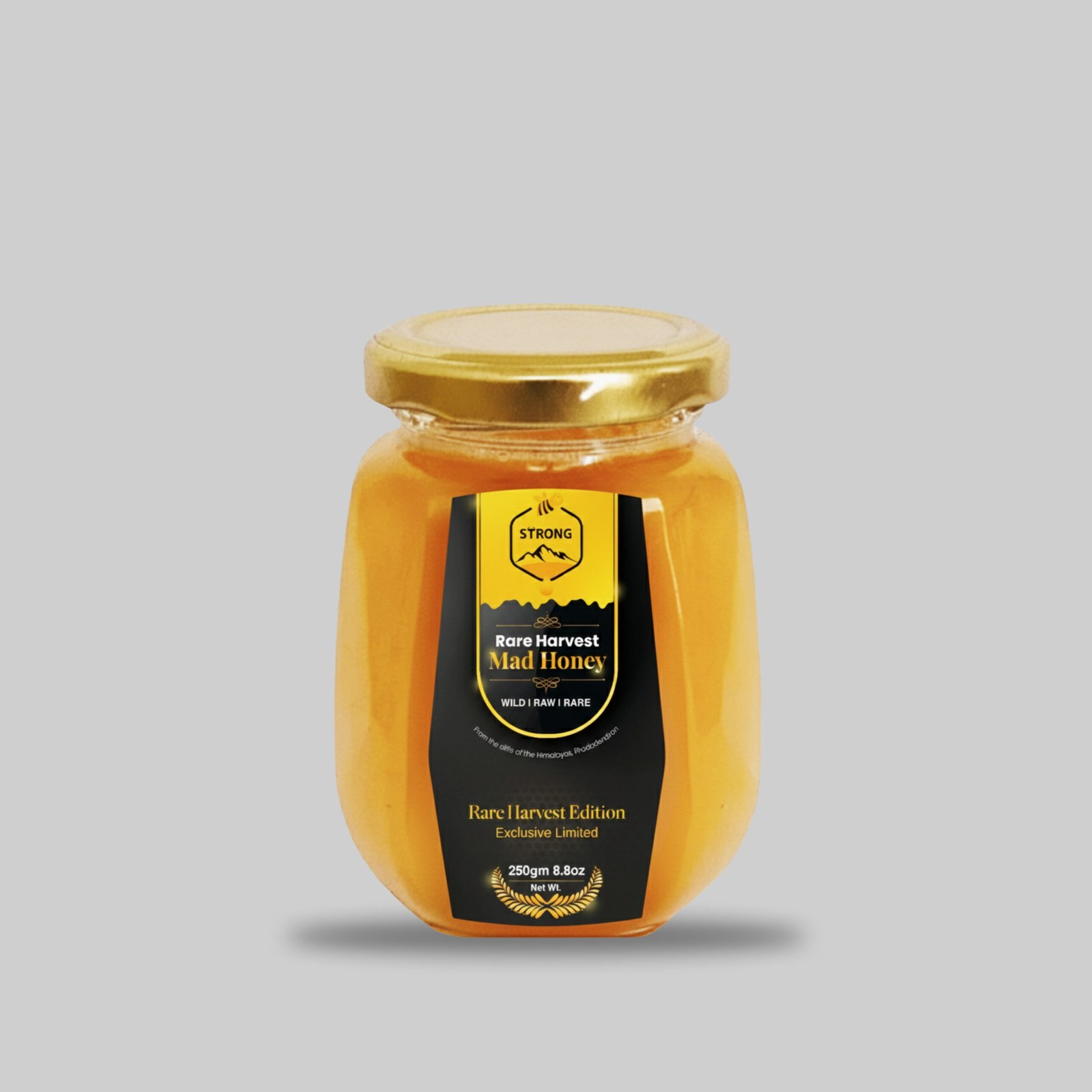
The Himalayan honey bee, Apis laboriosa, nests on high cliffs. In Nepal, bee researchers say this species produces the cliff honey known as mad honey. When rhododendrons bloom, their nectar can carry grayanotoxins into the honey. Mad honey in Turkey comes from a different bee, Apis mellifera caucasica. Grayanotoxins can cause poisoning, so regulators treat mad honey as a food safety issue. Learn more in our guide to Nepali mad honey, our complete guide to mad honey, and our guide to whether mad honey is legal. To spot genuine Himalayan honey, read our guide to original mad honey.
Why Is Apis dorsata Important?
Apis dorsata is a major wild pollinator in tropical Asia, and it supports forest ecosystems. It also faces threats. Forest loss removes the tall trees it nests in, and destructive honey hunting can wipe out whole colonies. The bee is also a host of Tropilaelaps mites. Australia’s Department of Agriculture warns that these mites could infest Australian bees, so the country works to keep giant honey bees out and asks people to report any bees they do not recognize.
Apis dorsata FAQ
What is Apis dorsata?
Apis dorsata is the giant honey bee, or rock bee, a wild honey bee of tropical Asia. It builds one large open comb under branches, cliffs, or buildings.
Are Apis dorsata dangerous?
Yes, they can be. They defend their nests fiercely, and a mass attack can cause serious illness. Most people stay safe by keeping their distance and never disturbing a nest.
How big is Apis dorsata?
Workers are about 17 to 20 mm long. Australia’s Department of Agriculture says they can reach 2 cm and are 30 to 50 percent larger than other honey bees. Some sources report up to 3 cm.
What is the largest honey bee?
The largest honey bee is Apis laboriosa, the Himalayan giant honey bee. It is slightly larger than Apis dorsata.
Is the Himalayan honey bee the same as Apis dorsata?
No. The Himalayan honey bee is Apis laboriosa. Scientists once treated it as a mountain form of Apis dorsata, but most now treat it as a separate species.
Can Apis dorsata be kept in hives?
No. It builds open combs and migrates with the seasons, so hive boxes cannot hold it. People harvest its honey from wild colonies.
Does Apis dorsata make mad honey?
No. Nepal’s mad honey comes mainly from Apis laboriosa, which feeds on rhododendron nectar. Apis dorsata lives mostly in warmer, lower regions.
Final Answer: What Is Apis dorsata?
Apis dorsata is the giant honey bee of tropical Asia, a large, wild, open-nesting bee that defends its comb with mass attacks and shimmering waves. It cannot be kept in hives, and it is a different species from the Himalayan honey bee, Apis laboriosa, which makes Nepal’s cliff honey. Admire these bees from a distance, and respect the honey hunters who risk a great deal to harvest their honey.
Sources and References
- https://www.agriculture.gov.au/biosecurity-trade/pests-diseases-weeds/plant/identify/exotic-bees
- https://www.agriculture.gov.au/biosecurity-trade/import/arrival/pests/giant-honey-bee
- https://pmc.ncbi.nlm.nih.gov/articles/PMC2528003
- https://pmc.ncbi.nlm.nih.gov/articles/PMC5708602
- https://www.fda.gov/food/foodborne-illness-contaminants/natural-toxins
Disclaimer: This article gives general information only. Never approach or disturb a wild bee nest. If you are stung many times or have a severe reaction, seek emergency medical care.