
Mad Honey Benefits: What Traditional Use Says, and What Grayanotoxin Really Does
An honest, complete guide to Mad Honey's traditional benefits, its effects, and the safety facts every buyer should read before trying authentic Himalayan Mad Honey.
What Is Mad Honey?
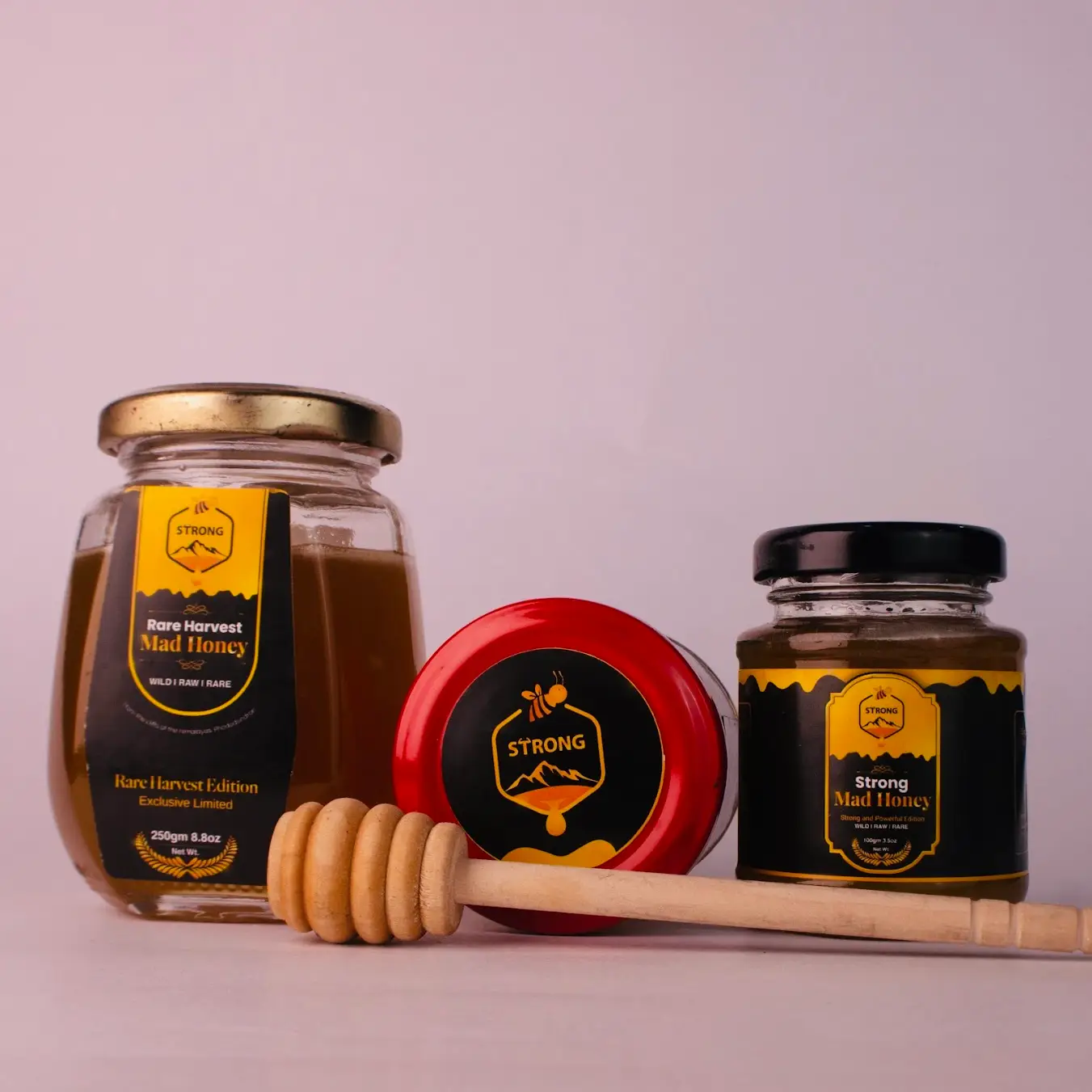
Mad Honey is a rare, wild honey produced by bees that forage on Rhododendron flowers growing on steep Himalayan cliffs in Nepal and mountain regions along Turkey's Black Sea coast. Unlike ordinary honey, it has a darker color, a sharper, slightly bitter taste, and a natural compound called grayanotoxin — the reason it's sometimes referred to as "mad" honey.
It's collected by hand, often by indigenous honey-hunting communities such as the Gurung people of Nepal, who climb exposed rock faces using rope ladders to reach wild hives — a practice that has continued largely unchanged for generations.
Rhododendron Honey: Why the Flower Matters
Most honey takes on mild traits from whatever flowers bees visit. Rhododendron honey is different — the nectar of certain rhododendron species (particularly Rhododendron ponticum and Rhododendron luteum) naturally contains grayanotoxins, compounds that pass through into the finished honey largely intact. This is what separates Mad Honey from every other honey variety on the market, and why it can't be replicated with regular bee farming. For a full side-by-side breakdown of how it compares to ordinary honey, see our guide on Regular Honey vs Mad Honey.
Because rhododendron forests only bloom at specific altitudes and seasons, genuine rhododendron honey is naturally limited in supply — one reason authentic Mad Honey commands a premium price compared to standard honey. You can read more about verifying authenticity on our Original Mad Honey guide.
Why Mad Honey Is Sometimes Called "Hallucinogenic Honey"
401 BCE
Mad Honey has a documented history stretching back over two thousand years. One of the earliest written accounts comes from the Greek historian Xenophon, who described soldiers in his army becoming disoriented after eating wild honey near the Black Sea in 401 BCE.
Ottoman Era
Centuries later, similar accounts appear in Ottoman-era Turkish records from the same region. We cover this full history, including the Himalayan honey-hunting tradition behind it, in our guide on Mad Honey's Traditional History.
The Nickname
The nickname "hallucinogenic honey" comes from grayanotoxin's effect on the nervous system: in larger amounts, it can cause light-headedness, altered perception, and a warm, floating sensation. This is also why the honey has to be treated with real caution rather than eaten like a regular spoonful of honey — a point we cover in full in the safety section below, and in more depth in our guide to understanding grayanotoxin.
What Does Mad Honey Do? Effects Explained
In small, controlled amounts, grayanotoxin acts on sodium channels in the body's nerve and muscle cells, which is why users commonly describe a gentle warming sensation, physical relaxation, and mild lightheadedness shortly after consuming a small quantity. These effects are temporary and tend to build gradually rather than instantly. Curious whether that sensation actually translates into energy? Our guide Does Mad Honey Give Energy? breaks down what's tradition and what's marketing. For the calmer side of the same compound, see Mad Honey Relaxation Claims and Mad Honey and Sleep.
Because sensitivity to grayanotoxin varies significantly from person to person — depending on body weight, heart health, and the potency of the specific batch — the same small amount can affect two people very differently. This is precisely why we recommend starting with far less than you might expect, and why the safety guidance further down this page isn't optional reading.
Mad Honey Benefits: What Traditional Use Says
Mad Honey is not an approved medical treatment, and we don't present it as one. What follows are benefits associated with traditional, generational use in Himalayan and Anatolian communities — framed honestly, as tradition rather than clinical fact.
Traditional Energy Support
In small amounts, Mad Honey has traditionally been used as a natural pick-me-up, favored over refined sugar by some rural communities. Read the full guide →
Traditional Relaxation
Some households traditionally take a small amount in the evening, associating it with physical ease and a calmer state of mind. Read the full guide →
Digestive Comfort
Like other raw, unfiltered honeys, small quantities have traditionally accompanied meals to support digestive comfort.
Raw Nutrient Content
Because it's unprocessed, Mad Honey retains natural enzymes and pollen typically lost in commercial honey filtration.
Cultural & Ceremonial Value
In parts of Nepal, Mad Honey is traditionally shared in small amounts during gatherings, valued for its rarity as much as its effects. Read the full history →
Raw Honey Antioxidants
Like other raw honeys, Mad Honey naturally contains antioxidant compounds derived from its floral source. Read the full guide →
Mad Honey Benefits for Men and Women
Mad Honey holds a particular place in traditional wellness practices across Nepal and Turkey, where small amounts have historically been shared as part of vitality-focused customs — traditionally associated with men's physical labor, though women have played an equally important role in the broader tradition. These uses are cultural and traditional rather than clinically proven, but they're a significant part of why Mad Honey built its reputation in the first place. Some buyers are also drawn to its separate, more debated reputation around libido, which we address honestly in its own guide.
We've put together full breakdowns of these traditional uses, what's supported by evidence, and what to realistically expect:
For Men
Traditional stamina and vitality use, and where modern marketing overstates it. Mad Honey Benefits for Men → · Deep dive: Men's Vitality →
For Women
The overlooked traditional role women have played, plus safety notes specific to pregnancy. Mad Honey for Women →
Libido
An honest look at where this claim comes from and what's actually evidence-backed. Mad Honey and Libido: Evidence →
Grayanotoxins in Mad Honey: The Full Safety Picture
We'd rather earn your trust with facts than lose it with hype. Grayanotoxin, the natural compound behind Mad Honey's effects, is well documented in medical literature. Case reports of "mad honey poisoning" — caused by consuming too much at once — are published in peer-reviewed journals indexed on PubMed and referenced by the NIH, particularly from regions of Turkey where mad honey is traditionally consumed. For the full mechanism behind these effects, see our guide on Understanding Grayanotoxin, and for what the published research actually shows versus what's simply marketed, see Mad Honey Scientific Evidence.
Before You Try Mad Honey, Know This:
- Start with far less than a regular spoonful. Sensitivity varies significantly between individuals.
- Never exceed the amount stated on your product's packaging. More is not "more effective" — it's simply riskier.
- Avoid entirely if you have a heart condition, low blood pressure, or take heart/blood pressure medication, unless your doctor has approved it. See our full guide on Mad Honey and Blood Pressure Risk.
- Do not combine with alcohol, sedatives, or other medications without medical advice.
- Pregnant or breastfeeding individuals should avoid Mad Honey entirely.
- Seek medical attention if you experience dizziness, blurred vision, excessive sweating, or an irregular heartbeat after consuming it.
For a complete walkthrough of safe usage and who should avoid Mad Honey altogether, see our full precautions guide →
How to Use Mad Honey Safely
If you're trying Mad Honey for the first time, patience matters more than quantity. Take a very small taste — noticeably less than you would of regular honey — on its own, away from alcohol or medication, and wait at least 30–45 minutes before considering any more. Everyone's body responds differently, so there is no "standard" amount that's right for every person.
Always follow the specific quantity guidance printed on your product label, since potency naturally varies batch to batch depending on the concentration of rhododendron nectar. If you're unsure, the safest approach is always the smallest amount possible.
A Traditional Recipe: Honey Lemonade
In parts of Nepal, raw honey is traditionally stirred into warm lemon water as a simple household drink — valued for its taste and as a comforting way to start the morning. If making this with Mad Honey specifically, treat it with the same caution as eating it directly: use only a very small amount (well under what a recipe using regular honey would call for), and never use it as a way to mask the taste of a larger dose.
Our Mad Honey Collection
Every jar is sourced directly from trusted harvesters in Nepal and Turkey. Explore the full range below.
Rare Harvest Mad Honey
Our most limited batch, hand-harvested from high-altitude cliffside hives in a single short season each year.
Shop Rare Harvest →Medicinal Mad Honey
Selected for traditional wellness use, raw and unfiltered, with the potency profile our returning customers ask for.
Shop Medicinal Mad Honey →Trip Mad Honey
Our strongest batch, sourced from higher-altitude rhododendron forests. Read the safety section above before ordering.
Shop Trip Mad Honey →Sourcing & Authenticity
With rising demand, the market has seen a growing number of diluted or fake "mad honey" products. Ours is sourced directly from harvesters in Nepal and Turkey using traditional, generational methods — nothing added, nothing diluted.
Want to know how to tell real Mad Honey from fake? We've written a full identification guide: How to Identify Original Mad Honey →
Curious specifically about our Nepal-origin batches? See our dedicated Nepali Mad Honey page → for harvesting details and regional differences.
Explore Our Complete Mad Honey Library
Every claim on this page links to a full, in-depth guide covering tradition, evidence, and safety for that specific topic. Start with whichever one matches what brought you here.
Does Mad Honey Give Energy?
A practical look at the stamina reputation and how it compares to caffeine.
EffectsMad Honey and Sleep
The lesser-known evening tradition behind this same compound.
EffectsMad Honey Relaxation Claims
What's behind the calming reputation, and how to try it responsibly.
VitalityMad Honey and Men's Vitality
Tradition versus overstated marketing, explained honestly.
VitalityMad Honey for Women
The overlooked history, plus pregnancy-specific safety notes.
VitalityMad Honey and Libido: Evidence
Separating the legend from what's actually documented.
CompositionMad Honey Antioxidant Content
What the numbers actually show, compared to Manuka honey.
CompositionUnderstanding Grayanotoxin
What this compound is, and why "benefit" isn't quite the right word.
CompositionRegular Honey vs Mad Honey
Every difference explained, side by side.
HistoryMad Honey's Traditional History
The honey hunt, the rituals, and generations of Himalayan knowledge.
ResearchMad Honey Scientific Evidence
What's actually been studied versus what's simply marketed.
SafetyMad Honey and Blood Pressure Risk
The clearest, most important safety warning on this entire site.
Frequently Asked Questions
What is Mad Honey?
Mad Honey is a rare honey produced from rhododendron nectar in Nepal and Turkey, containing grayanotoxin — a natural compound responsible for its distinctive effects.
What does Mad Honey do?
In small amounts, it's commonly associated with a warm, relaxing sensation and mild light-headedness. Effects vary by person and by how much is consumed.
Is Mad Honey the same as "hallucinogenic honey"?
Yes — it's the same product. The nickname comes from grayanotoxin's effect on the nervous system when consumed in larger amounts.
Is Mad Honey safe?
In small, carefully measured amounts it has been consumed traditionally for generations. Overconsumption can cause adverse effects — read the full safety section above before trying it.
Is Mad Honey legal?
Yes, in most countries, including the UK and USA, provided it's imported and labeled according to local food-safety regulations.
Where can I buy authentic Mad Honey?
Directly from trusted, transparent sources. See our UK delivery page or USA delivery page for region-specific ordering details.
Ready to Try Authentic Mad Honey?
Sourced responsibly from Nepal and Turkey. Every order ships with clear usage guidance so you can enjoy it safely.
Shop Mad HoneyUK Delivery